
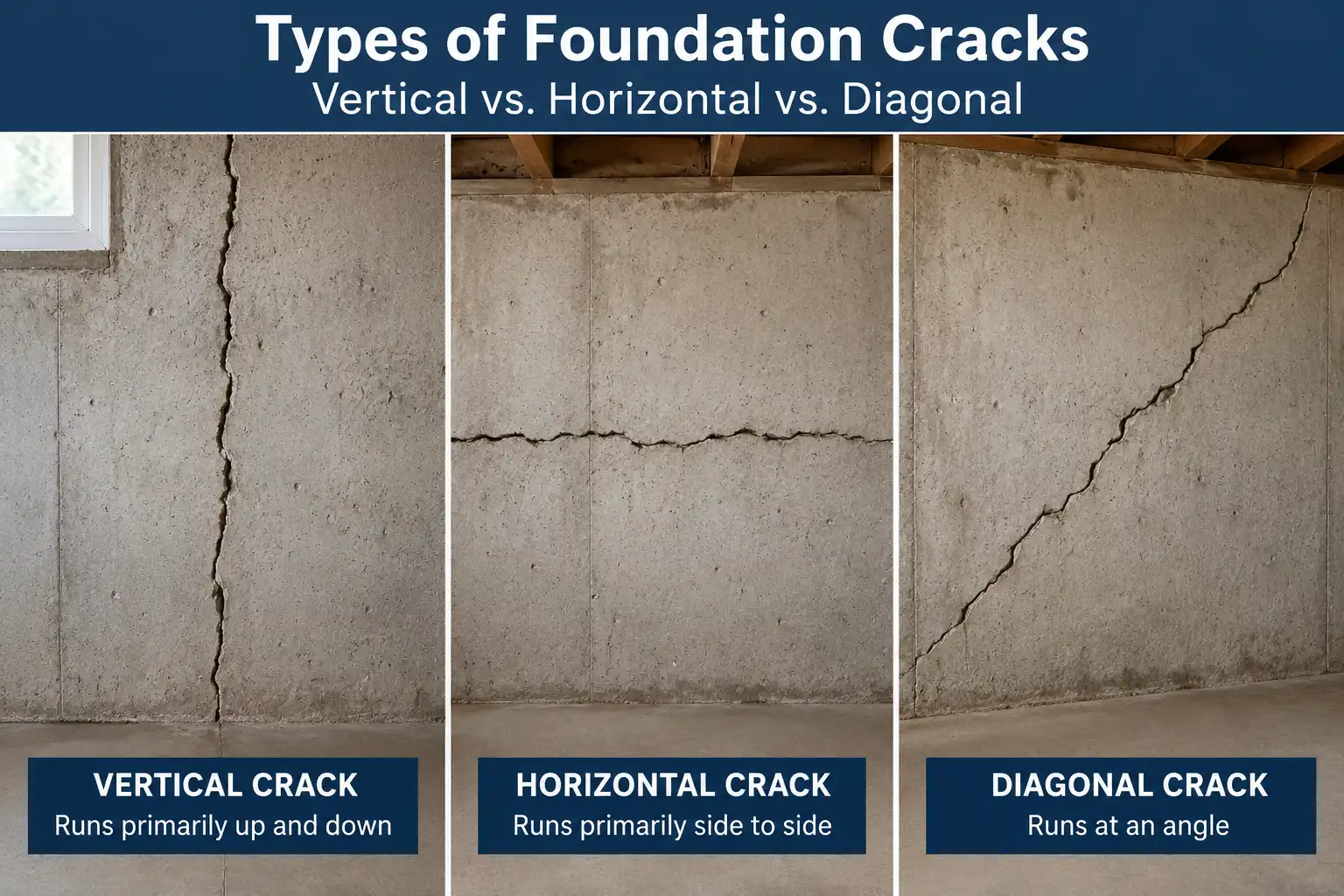
Finding a crack in a basement or foundation wall naturally raises questions. Is it simply a crack in the concrete, or could it be connected to movement elsewhere in the foundation?
One useful place to start is the crack’s direction.
Vertical, horizontal, and diagonal cracks can develop under different conditions. Masonry foundations may also develop stair-step cracks that follow the mortar joints between blocks or bricks.
However, the type of foundation crack you see does not provide a complete diagnosis by itself. Its location, whether the wall has moved, whether the crack is changing, the type of foundation, and other symptoms around the home all matter.
The American Concrete Institute’s guidance on concrete cracking recognizes multiple potential causes of cracks and treats evaluation as an important step in determining the appropriate response. ACI guidance on evaluating concrete cracks
For St. Louis homeowners, understanding these differences can help you document what you are seeing and decide when a professional evaluation may be worthwhile.
What Can the Direction of a Foundation Crack Tell You?
Crack direction is one piece of evidence.
A crack that runs primarily up and down developed differently from one that extends horizontally across a basement wall. A diagonal crack creates another pattern, while cracks in concrete-block foundations may travel through mortar joints instead of following a straight line.
That makes orientation useful when evaluating types of foundation cracks, but it should be considered alongside questions such as:
- Is the crack new or has it been there for years?
- Does it appear to be growing or reopening?
- Are the two sides of the crack still aligned?
- Is the wall bowing, leaning, or otherwise displaced?
- Does water enter through the crack?
- Are other cracks or changes appearing nearby?
- Are doors, windows, floors, or walls elsewhere in the home changing?
The American Concrete Institute notes that cracks in concrete structures can have numerous causes and that evaluating cracking is part of determining an appropriate repair approach.
If you are noticing several symptoms rather than one isolated crack, our guide to signs of foundation problems explains additional conditions worth watching.
Types of Foundation Cracks at a Glance
| Crack Pattern | What It Looks Like | What It May Be Associated With | What Else to Check |
|---|---|---|---|
| Vertical | Runs primarily up and down | Concrete shrinkage, movement, settlement, or other conditions | Change over time, leakage, displacement, location |
| Horizontal | Runs primarily side to side | May accompany lateral loading or movement of a foundation wall | Bowing, leaning, offset, displacement, progression |
| Diagonal | Runs at an angle across concrete or masonry | May occur where different areas of a structure are moving differently | Crack shape, location, displacement, other symptoms |
| Stair-step | Follows mortar joints in a stepped pattern | May accompany different forms of masonry or foundation movement | Wall alignment, displaced blocks, other cracking |
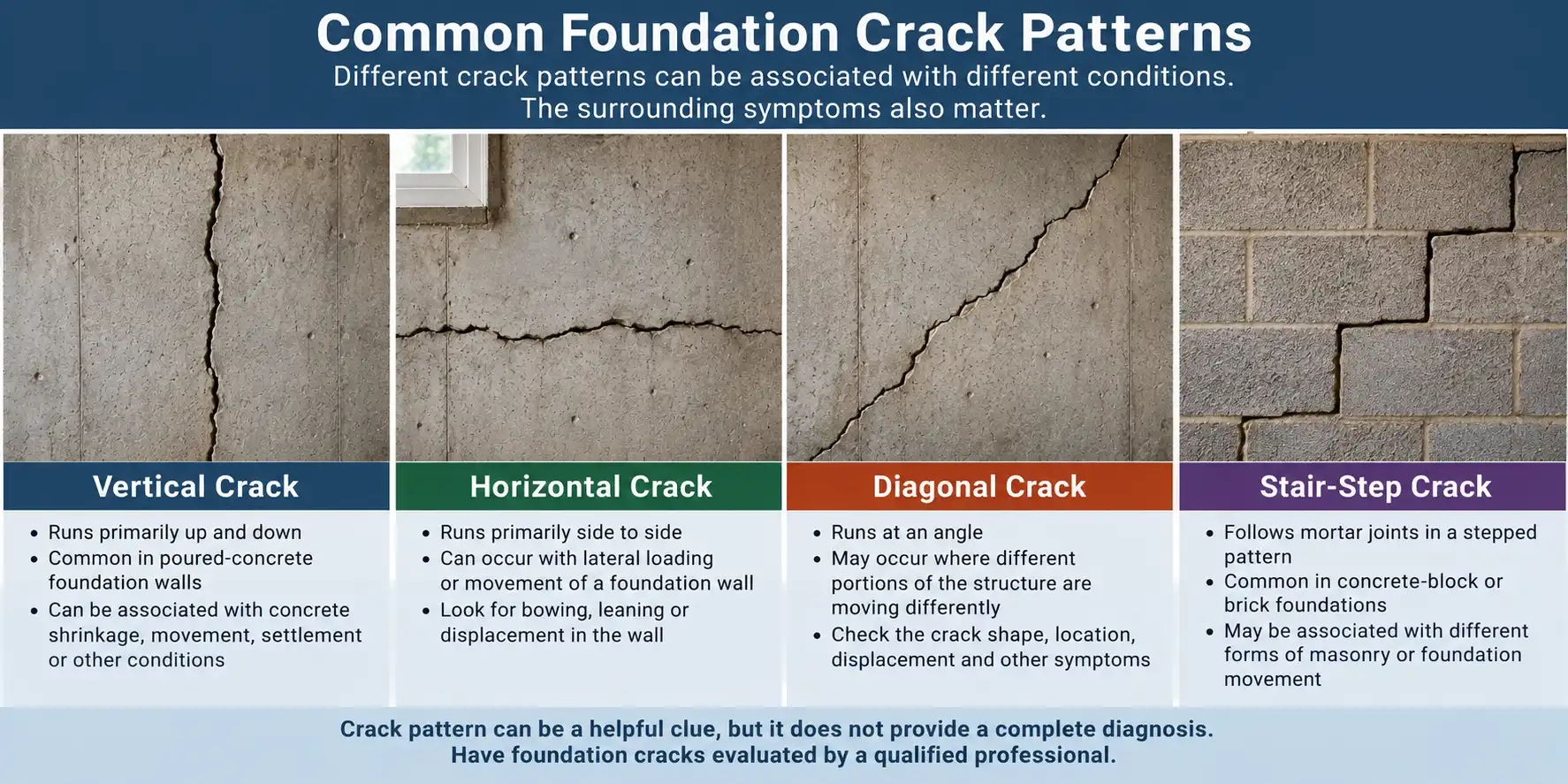
This table is best used to identify a crack pattern, not to determine whether a foundation needs structural repair.
A professional evaluating a crack will generally need more information than orientation alone.
Vertical Foundation Cracks
A vertical foundation crack runs primarily from top to bottom through a wall. Some may be almost perfectly vertical, while others wander slightly as they travel through concrete.
Vertical cracks are commonly seen in poured-concrete foundation walls.
What Can Cause a Vertical Foundation Crack?
Concrete changes as it cures and dries, and cracking can develop for several reasons. A vertical crack may be associated with shrinkage or different forms of movement, but its orientation by itself does not establish the cause.
That is why statements such as “vertical cracks are always harmless” are too broad.
A homeowner should pay attention to the conditions around the crack.
For example, a thin crack that appears unchanged over a long period provides different information from one that is visibly widening, has displacement from one side to the other, repeatedly reopens after repair, or develops alongside other changes in the home.
What If a Vertical Crack Leaks?
A foundation crack can also create a pathway for moisture.
University of Missouri Extension recommends inspecting basement walls and floors for cracks when trying to identify the source of basement leakage. University of Missouri Extension guidance on leaky basements
Water coming through a vertical crack does not automatically mean the crack is structurally significant. Likewise, sealing the visible opening does not necessarily tell you why it developed.
If moisture is consistently entering at the crack, both the crack and the surrounding water conditions should be evaluated.
For more information about water appearing during storms, see our guide to basement leaking after heavy rain.
If the crack itself is the primary concern, Crack Wizard also provides foundation crack repair in St. Louis.
Horizontal Foundation Cracks
A horizontal foundation crack travels primarily from side to side across a wall.
Of the common crack orientations, horizontal cracking deserves particular attention because it can occur along with lateral movement or loading of a below-grade foundation wall.
Why Lateral Pressure Matters
Unlike an interior partition wall, a basement foundation wall may have soil against its exterior side.
Residential building-code provisions address lateral soil loads when foundation walls are designed. The International Residential Code, for example, includes foundation-wall requirements that account for soil classification, wall height, backfill height, reinforcement, and lateral loading. ICC residential foundation provisions
That does not mean exterior soil pressure is automatically the cause of a particular horizontal crack. It explains why the condition of the entire wall matters when horizontal cracking appears.
Look Beyond the Crack
When you notice a horizontal crack, check whether:
- the wall appears to curve inward
- one portion of the wall is offset from another
- the crack follows a consistent level across much of the wall
- the crack is changing
- additional diagonal or stair-step cracks are present
- the wall appears to lean or shift
A horizontal crack does not prove that the wall is bowing. However, horizontal cracking can occur alongside visible wall movement.
Our guide to bowing basement wall warning signs explains what other conditions homeowners can look for before assuming the crack alone identifies the problem.
If wall movement is suspected, evaluating the overall foundation condition is more useful than simply sealing the visible crack. Crack Wizard’s foundation repair services in St. Louis cover foundation movement and basement-wall conditions in addition to individual cracks.
Diagonal Foundation Cracks
Diagonal cracks travel across a foundation wall at an angle.
Their appearance can vary considerably. Some begin near a corner or opening, while others extend through a larger section of wall. In masonry, a diagonal pattern may follow mortar joints rather than cutting directly through individual blocks.
What Can a Diagonal Crack Mean?
One possible condition associated with diagonal cracking is differential movement.
Differential settlement occurs when one part of a foundation moves differently from another. Because different portions of the structure are not moving equally, visible symptoms may develop in the foundation or elsewhere in the home.
However, seeing a diagonal crack does not prove that differential settlement is occurring.
The crack still needs to be considered alongside its location, wall construction, displacement, surrounding conditions, and whether other symptoms are present.
For a deeper explanation of why foundations can move downward, see our guide to the causes of foundation settlement.
Homeowners trying to determine whether several changes may be related may also find our comparison of house settling vs. foundation problems useful.
What About Stair-Step Foundation Cracks?
Stair-step cracking deserves separate attention because it is particularly relevant to masonry foundations.
Rather than forming one continuous line through poured concrete, a crack in a concrete-block or brick wall may follow the mortar joints. It moves horizontally along one joint, vertically to another joint, and horizontally again, creating a pattern that resembles stairs.
A stair-step crack may sometimes be associated with movement in the wall or foundation, but the pattern alone does not determine the cause.
Look at the rest of the masonry as well.
For example, are individual blocks displaced? Does one portion of the wall sit farther inward than another? Is the wall visibly curved? Are there additional cracks nearby?
Those observations provide more context than the stair-step pattern alone.
Why Foundation Material Matters
Not every foundation reveals movement in the same way.
Poured-Concrete Foundations
A poured-concrete wall is constructed as a relatively continuous section of concrete. Cracks may travel directly through the wall and can appear vertical, horizontal, or diagonal.
The crack’s shape, location, displacement, and surrounding conditions all contribute to understanding what may be happening.
Concrete-Block and Masonry Foundations
Concrete-block walls consist of individual masonry units connected by mortar joints.
Because those joints create natural boundaries between units, cracking may follow the mortar rather than passing directly through a block. That is why horizontal cracks along mortar joints and diagonal stair-step patterns are commonly discussed when evaluating masonry walls.
The International Residential Code also distinguishes among different foundation-wall construction methods when addressing wall design and lateral loading.
Knowing what your foundation is made from therefore helps put the crack pattern in context.
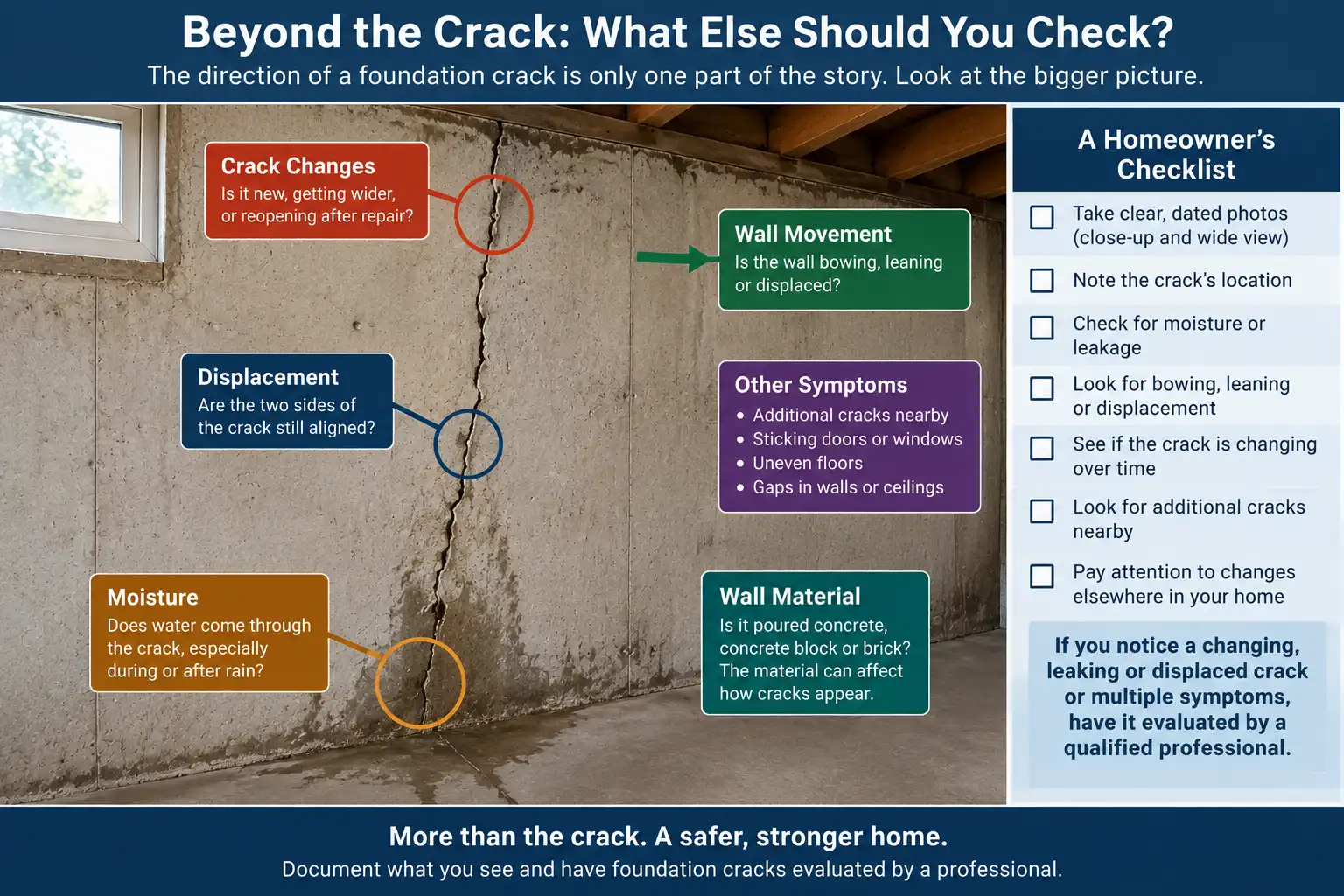
Crack Direction Is Only Part of the Evaluation
If you remember one thing from this guide, it should be this:
The direction of a crack helps describe what you are seeing. It does not tell the complete story.
Other observations can be equally important.
Has the Crack Changed?
A crack that appears stable over a long period provides different information from one that has recently lengthened, widened, or reopened.
Homeowners do not need to perform an engineering survey themselves. Simply keeping dated photographs can make it easier to determine whether a visible condition appears to be changing.
Is There Visible Displacement?
Look at the surfaces on each side of the crack.
Do they remain relatively aligned, or does one side appear farther inward or outward than the other?
Visible offset can provide information that crack direction alone does not.
Is the Wall Bowing or Leaning?
Step back and look along the wall rather than focusing exclusively on the crack.
An inward curve, leaning section, displaced blocks, or other wall movement deserves consideration as part of the overall condition.
Is Water Coming Through the Crack?
Moisture can use cracks and other openings as pathways into a basement.
If water appears primarily after rainfall, observations about exterior drainage, downspouts, grading, basement windows, and the location of the interior leak may help identify where the water is coming from.
Crack Wizard’s basement waterproofing services address basement water problems where waterproofing is appropriate.
Are Other Symptoms Appearing Around the Home?
Consider whether the foundation crack is isolated or part of a broader pattern.
Other observations may include changes around doors or windows, wall or ceiling separations, floor changes, additional foundation cracks, or previously repaired areas that reopen.
None of these symptoms individually proves that structural foundation movement is occurring. When several appear together or are changing, however, they provide more information for an evaluation.
What Homeowners Can Safely Check and Document
You do not need to diagnose the cause yourself to gather useful information.
Start with simple observations:
- Take clear photographs. Include both close-up images of the crack and wider images showing its location on the wall.
- Record the date. Dated photographs can help show whether the visible condition changes.
- Note where the crack is located. Record whether it is near a corner, window, door, floor line, or another feature.
- Look for moisture. Note whether the crack becomes damp or leaks during or after rain.
- Look at the entire wall. Check for obvious bowing, leaning, displaced sections, or additional cracks.
- Consider other changes around the home. Pay attention to multiple symptoms rather than treating the crack as an isolated clue.
Avoid relying on a universal crack-width rule to determine whether your home has a structural problem. The significance of a crack depends on the wall, the structure, and surrounding conditions.
When Should a Foundation Crack Be Evaluated?
A professional evaluation may be appropriate when a foundation crack is:
- new or visibly changing
- reopening after a previous repair
- accompanied by displacement
- associated with bowing or leaning of the wall
- repeatedly allowing water into the basement
- appearing alongside several other signs of movement
- part of a larger pattern of cracking
- difficult to interpret confidently from appearance alone
These conditions do not automatically mean major foundation repair will be required.
The purpose of an evaluation is to understand the condition before choosing a response.
Foundation Cracks in St. Louis Homes
Whether a crack runs vertically, horizontally, diagonally, or through the mortar joints of a masonry foundation, its orientation should be considered together with what is happening around it.
For St. Louis-area homeowners, Crack Wizard evaluates basement and foundation cracks as well as conditions involving foundation movement and water intrusion.
If you have discovered a crack and are unsure what it means, documenting the crack and having the surrounding conditions evaluated can provide more useful information than trying to classify the problem from direction alone.
Frequently Asked Questions About Types of Foundation Cracks
Are vertical foundation cracks serious?
A vertical crack is not automatically serious or harmless. Vertical cracking can develop under different conditions, so factors such as displacement, change over time, moisture, location, and other symptoms should also be considered.
Are horizontal foundation cracks worse than vertical cracks?
Horizontal cracks deserve attention because they can occur alongside lateral loading or movement of foundation walls. However, crack direction alone cannot determine the structural condition of a particular wall. Look for bowing, displacement, progression, and other symptoms as well.
What does a diagonal foundation crack mean?
A diagonal crack may sometimes occur where different portions of a foundation or structure are moving differently, but appearance alone cannot establish the cause. Its location, shape, displacement, wall type, and surrounding symptoms all provide important context.
Is a stair-step crack the same as a diagonal crack?
They can have a similar overall direction, but a stair-step crack typically follows mortar joints in brick or concrete-block construction. A diagonal crack in poured concrete may travel directly through the wall rather than following masonry joints.
Can a foundation crack cause a basement leak?
A foundation crack can provide a pathway for water under certain conditions. University of Missouri Extension recommends checking basement walls and floors for cracks when investigating basement leakage.
A leaking crack still does not tell you why the crack developed, so both the water-entry pathway and the condition of the foundation should be considered.
Should I repair a foundation crack myself?
The appropriate repair depends on what caused the crack, whether movement is occurring, whether water is entering, and the type of wall involved. Before treating a changing, displaced, leaking, or otherwise concerning crack as a surface repair, it is useful to determine what condition is actually present.
Understanding the Crack Is the First Step
Vertical, horizontal, diagonal, and stair-step foundation cracks create different visual patterns, but orientation is only one part of evaluating a foundation.
Pay attention to whether the crack is changing, whether the wall has moved, whether moisture is present, and whether other symptoms are developing around the home.
If you have discovered a foundation or basement-wall crack in the St. Louis area, Crack Wizard can evaluate the visible conditions and help determine an appropriate next step. Learn more about foundation crack repair in St. Louis or request an inspection.