
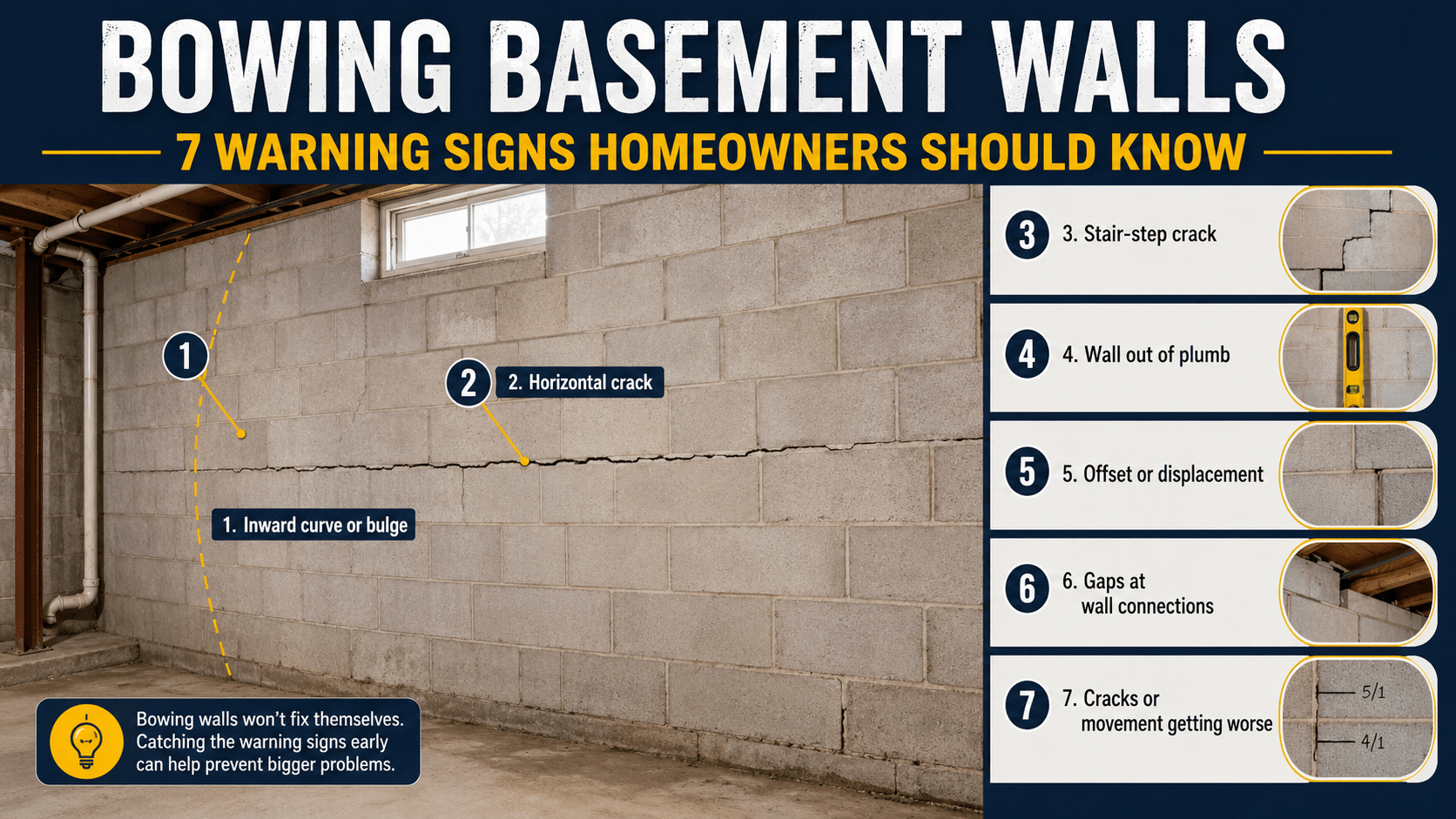
A basement wall does not have to look dramatically curved before you notice that something seems different. You may see a horizontal crack that was not there before, a mortar joint that looks uneven, or a section of wall that appears to push slightly inward.
These can be bowing basement wall signs, but appearance alone cannot tell you exactly what is happening or how serious the condition may be.
Concrete and masonry foundation walls are designed to resist forces from the soil outside them. The International Code Council’s model building-code provisions address lateral soil loads on foundation walls and, where applicable, hydrostatic pressure. At the same time, the American Concrete Institute notes that concrete cracking can have many possible causes.
For homeowners, the useful first step is not trying to diagnose the wall yourself. It is recognizing visible patterns, noting whether they are changing, and knowing when an evaluation may be appropriate.
What Is a Bowing Basement Wall?
A bowing basement wall has developed an inward curve or deflection instead of remaining relatively straight through its height.
Bowing is not exactly the same as leaning.
A bowed wall may curve inward through one portion of the wall while the top and bottom remain closer to their original positions. A leaning wall may appear tilted or shifted more uniformly from bottom to top. In some cases, a foundation wall can show characteristics of both.
Bowing can occur in poured-concrete walls as well as concrete-block or other masonry foundation walls. The visible symptoms may differ depending on how the wall was built.
A poured-concrete wall, for example, may develop a horizontal crack through the concrete. A block wall may show cracking along mortar joints, displacement between courses, or a combination of horizontal and stair-step cracking.
If the concern involves visible wall movement rather than an isolated crack, learn more about Crack Wizard’s foundation repair in St. Louis services.
7 Bowing Basement Wall Signs to Look For
No single symptom proves why a basement wall has moved. The pattern of conditions across the wall usually provides more useful information than one crack viewed by itself.
Here are seven signs worth paying attention to.
1. The Wall Has a Visible Inward Curve or Bulge
One of the clearest signs is a wall that no longer appears relatively flat.
Stand several feet away and look along the length of the wall. You may notice that the middle portion appears farther into the basement than the areas near the top or bottom.
On a block wall, the curve may extend through several courses. On poured concrete, the change can appear smoother and may be easier to notice when looking along the wall rather than directly at it.
A visible inward curve may indicate wall deflection, but it does not identify the cause or determine how much structural capacity remains. Those questions require evaluation of the actual wall and surrounding conditions.
2. A Horizontal Crack Runs Across the Wall
Horizontal cracking deserves attention because its orientation can sometimes accompany lateral movement of a foundation wall.
The crack may:
- extend across a large portion of the wall
- follow a mortar joint in a block foundation
- occur near the area where the wall appears to bend
- show visible offset or displacement from one side to the other
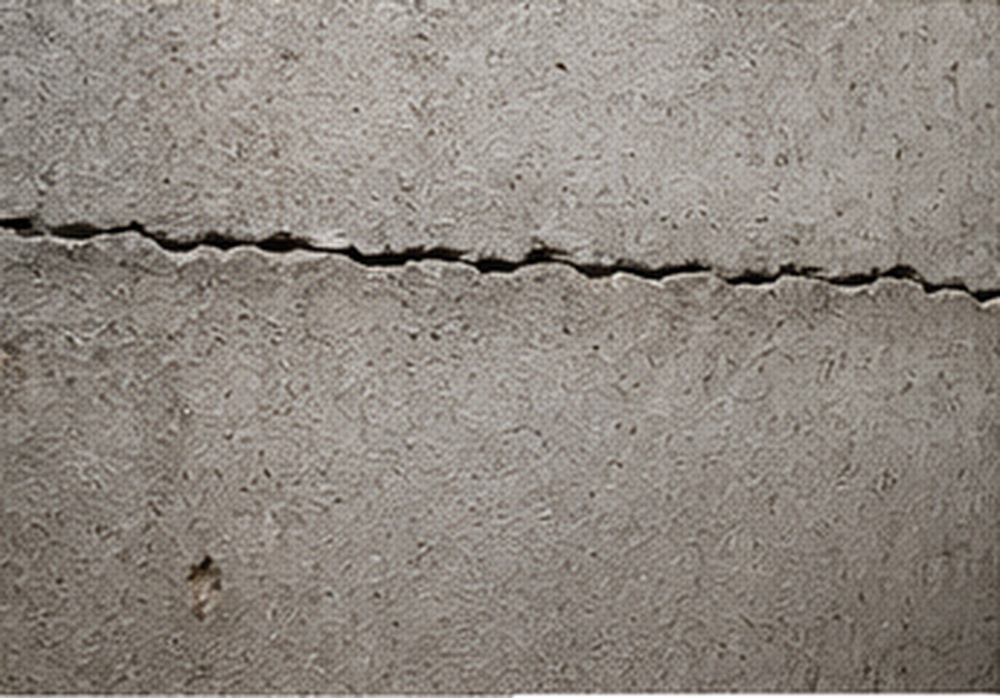
However, a horizontal crack should not automatically be treated as proof that a wall is bowing.
The American Concrete Institute’s guidance on concrete cracking emphasizes that cracks can have numerous causes and that their significance depends on the structure and surrounding conditions.
If a crack is the primary concern and the wall does not appear visibly displaced, Crack Wizard’s foundation crack repair page explains the company’s crack-repair services for St. Louis-area homes.
3. Stair-Step or Diagonal Cracks Appear in a Block Wall
Concrete-block and other masonry walls often reveal movement differently from a single poured-concrete wall.
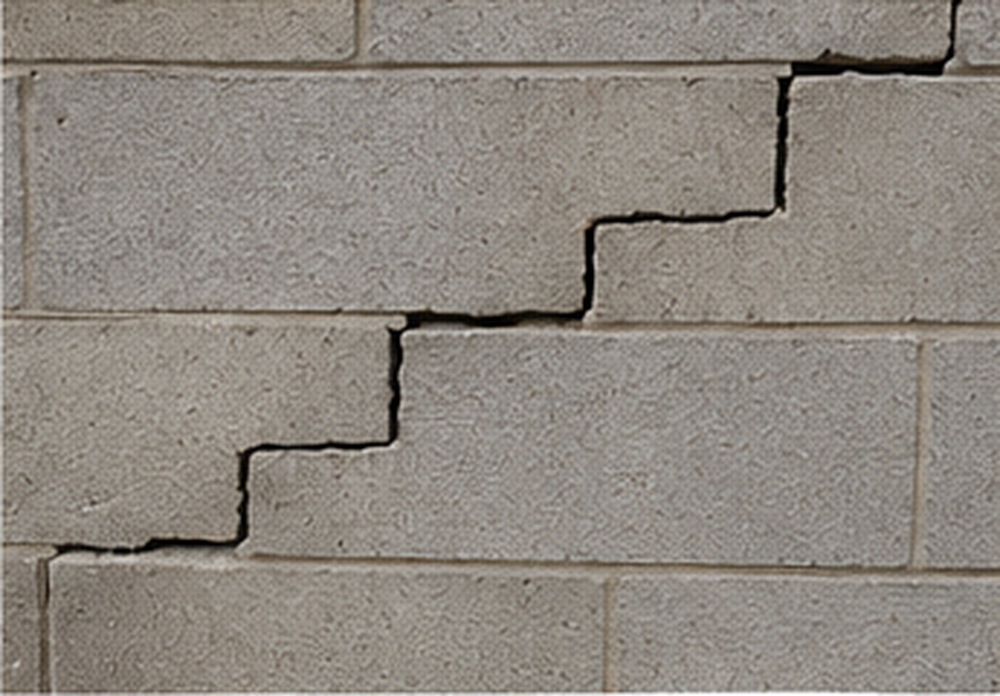
Instead of a straight crack through the material, cracking may follow mortar joints in a stair-step or diagonal pattern.
A homeowner might notice:
- cracks that move horizontally and then vertically through neighboring joints
- cracking near a corner
- separation along several mortar joints
- one portion of the block wall appearing slightly shifted relative to another
Stair-step cracking is not exclusive to bowing walls. Other types of foundation or masonry movement can produce similar patterns.
The important point is to look at the whole wall, including whether it appears curved, displaced, leaning, or different from before.
For other symptoms that may deserve attention around a home, see Crack Wizard’s guide to 10 warning signs of foundation problems.
4. The Wall Appears to Lean or Is No Longer Plumb
Sometimes the visible problem looks less like a curve and more like an overall tilt.
A wall that appears noticeably farther inward at the top than at the bottom, or vice versa, may have moved out of its previous alignment.
This distinction can be useful when describing what you see to a contractor or other qualified professional.
A bowed wall and a leaning wall are not necessarily experiencing the exact same type of movement, even though both conditions deserve closer evaluation when they are visible.
Avoid trying to determine structural safety by comparing the wall with a homemade numerical threshold. Wall construction, reinforcement, height, support conditions, displacement pattern, soil loads, and other factors can all influence what a measurement means.
5. Blocks or Crack Faces Appear Offset
Crack width gets a great deal of attention, but displacement can provide another important visual clue.
Look at the surfaces on both sides of a crack.
Do they still line up?
In a poured wall, one side of a crack may appear slightly farther inward than the other. In a block wall, one row of masonry may appear shifted relative to the course above or below it.
You may also notice that a previously flat surface now has a small ledge or offset.
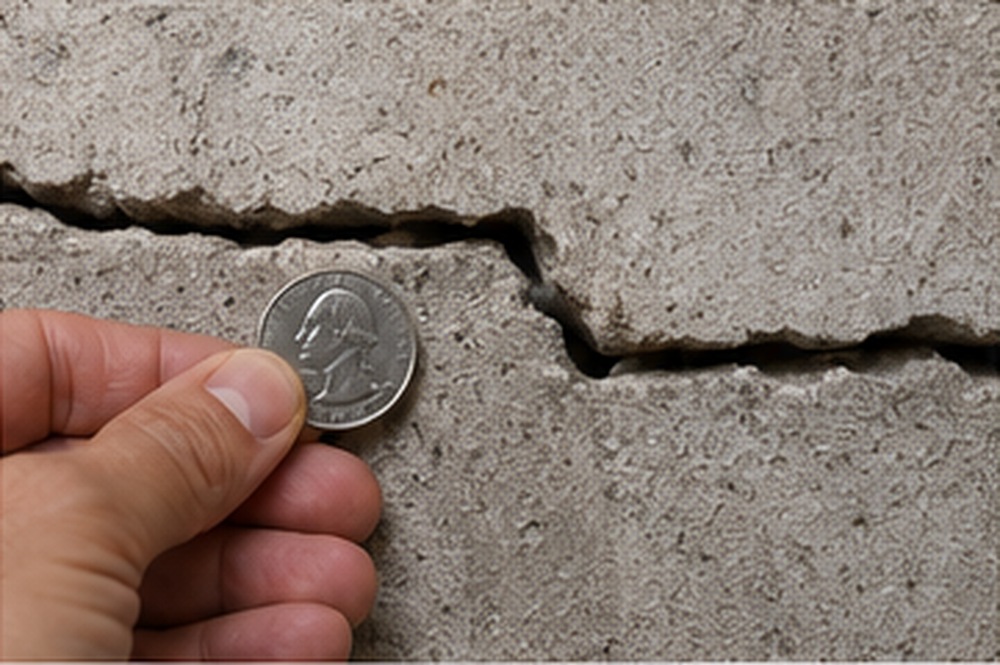
This does not tell you why the movement occurred, but it can indicate that the condition involves more than a simple line on the surface.
When documenting the wall, photographs taken from an angle can sometimes make visible displacement easier to compare over time than a straight-on photograph.
6. Gaps or Separation Develop at Wall Connections
Wall movement can sometimes show up where building components meet.
Depending on the construction, you may notice changes around:
- basement corners
- intersecting foundation walls
- the top of the foundation wall
- framing connections
- openings through or near the wall
A gap by itself can have several possible explanations, so this is another sign that should be considered together with the rest of the wall.
A new separation becomes more noteworthy when it occurs alongside horizontal cracking, visible inward deflection, displacement, or other signs of movement.
7. Cracks or Wall Movement Appear to Be Changing
One of the most useful things a homeowner can observe is whether the condition looks different over time.
For example, you might notice that:
- a crack seems longer or wider than it did previously
- a repaired crack has opened again
- additional cracking has developed nearby
- wall curvature has become easier to see
- a gap has increased
- displacement along a crack or mortar joint appears to have changed
You do not need to diagnose the change yourself.
Dated photographs can provide a useful record of what was visible at different times. Photograph the same section from a similar distance and angle when practical.
Crack Wizard’s guide to house settling vs. foundation problems also explains why patterns of symptoms and changes over time can be more informative than one isolated crack.
Bowing, Leaning, or Just Cracked? What Is the Difference?
These terms are sometimes used interchangeably, but they describe different observations.
| Condition | What You May See | What the Observation Tells You |
|---|---|---|
| Bowing | Part of the wall curves inward | Visible deflection is present and should be evaluated |
| Leaning | Much of the wall appears tilted | The wall may have moved out of its previous alignment |
| Horizontal crack | Crack runs primarily side to side | It can accompany lateral movement, but does not prove bowing by itself |
| Stair-step crack | Crack follows masonry joints diagonally | It can occur with several forms of masonry or foundation movement |
| Vertical crack | Crack runs primarily up and down | Its significance depends on surrounding conditions, displacement, leakage, and whether it is changing |
This is why crack direction is best treated as one clue rather than a diagnosis. The American Concrete Institute notes that cracking can develop for different reasons, making context important when evaluating what a crack may mean.
For a closer look at individual foundation cracks, visit Crack Wizard’s crack repair service page.
Why Can Basement Walls Bow Inward?
Basement foundation walls are different from most interior walls because soil is present against the exterior side of the wall.
Lateral Pressure From Soil
Foundation walls must be capable of resisting forces applied laterally by the soil surrounding them.
The International Building Code’s model provisions for soils and foundations address lateral soil loads acting on foundation walls. The forces involved can vary based on factors such as wall construction, backfill conditions, soil characteristics, and other site-specific circumstances.
That does not mean soil pressure is automatically the cause of every bowed basement wall. It simply explains why exterior conditions are relevant when foundation-wall movement is evaluated.
Water and Drainage Conditions
Water can also be part of the conditions surrounding a basement.
Model-code provisions address hydrostatic pressure and foundation drainage in applicable below-grade construction. University of Missouri Extension also explains that saturated soil outside basement walls can exert pressure against those walls during flooding conditions.
A wet basement does not prove that water caused a wall to bow.
Likewise, a bowed wall does not automatically mean that the property has a waterproofing problem.
However, recurring seepage, saturated conditions, or drainage concerns can provide useful context during an evaluation.
If water is also entering the basement, Crack Wizard’s basement waterproofing service addresses basement water-intrusion and drainage concerns.
Other Site and Structural Factors
The forces acting on a basement wall are only one part of the picture.
An evaluation may also need to consider the wall’s material and construction, reinforcement, support conditions, exterior grading, nearby loads, previous modifications, drainage conditions, and other property-specific factors.
That is why the appearance of the wall cannot tell a homeowner exactly what caused the movement.
What Can Homeowners Safely Check?
You can gather useful information without trying to perform a structural diagnosis.
Start by looking at the wall from several angles. Note whether there is an obvious inward curve and where that curve appears most noticeable.
Look at the direction and location of cracks. On block walls, pay attention to mortar joints and whether adjacent courses still align.
Check for visible displacement across cracks, changes near corners and openings, and separation where walls or other building components meet.
If you have older photographs of the same basement area, compare them with current conditions.
For conditions you want to monitor, take clear, dated photographs from approximately the same position. The goal is simply to document what is visible, not to determine whether a specific amount of movement is acceptable.
You can also review common signs of foundation problems elsewhere in the home to see whether additional visible changes are present.
Avoid attempting to straighten, brace, excavate beside, or otherwise structurally alter a bowing wall without appropriate professional guidance.
When Should a Bowing Basement Wall Be Evaluated?
Professional evaluation is appropriate when you see a basement wall that appears visibly bowed or leaning, particularly when the condition is accompanied by cracking, displacement, or signs that the wall is changing.
It is also reasonable to request an evaluation when you cannot tell whether the condition is an isolated crack or part of broader wall movement.
Consider having the wall evaluated when you observe:
- visible inward curvature
- horizontal cracking with apparent wall movement
- displaced blocks or crack faces
- new or increasing separation
- multiple related crack patterns
- movement that appears to be progressing
- a repaired area that has reopened or changed
If a wall appears to be changing rapidly or there are signs that make you concerned about immediate structural stability, avoid relying on a visual self-assessment. Limit access to the affected area as appropriate and consult a qualified professional who can evaluate the condition directly.
There is no useful universal rule that says every wall becomes unsafe after a particular crack width or amount of visible bowing. Structural significance depends on the wall and the conditions at the individual property.
How Are Bowing Basement Wall Repairs Determined?
The correct response depends on what the evaluation finds.
Factors that may need to be considered include the wall material, location and pattern of movement, amount of deflection, crack displacement, support conditions, exterior conditions, water or drainage issues, and whether movement appears to be ongoing.
That evaluation matters because repairing a crack and stabilizing a moving wall are not necessarily the same task.
Crack Wizard’s foundation repair service currently includes wall anchors and braces and carbon-fiber reinforcement among the available approaches for appropriate foundation-wall conditions.
The appropriate repair method still depends on the specific wall and property rather than the appearance of one crack.
Frequently Asked Questions About Bowing Basement Walls
What are the most common bowing basement wall signs?
Visible inward curvature, horizontal cracking, displaced masonry, stair-step cracking, a wall that appears out of alignment, separation at connections, and conditions that appear to be changing can all provide useful clues.
None of these signs alone identifies the cause or severity of the movement.
Does a horizontal basement wall crack mean the wall is bowing?
Not necessarily.
A horizontal crack can occur with lateral wall movement, but crack direction by itself does not establish that the entire wall is bowing. Look for additional conditions such as visible inward deflection, displacement, or changes elsewhere on the wall.
If the wall itself does not appear to be moving, learn more about foundation crack repair and why cracks should be evaluated in context.
What is the difference between a bowed wall and a leaning wall?
A bowed wall generally curves through part of its height. A leaning wall appears tilted more broadly from top to bottom.
A wall can potentially show elements of both types of movement.
Can a concrete-block basement wall bow?
Yes. Masonry foundation walls can experience lateral movement. Visible signs may include horizontal cracking along mortar joints, stair-step cracking, displaced block courses, or an inward curve.
The crack pattern still needs to be considered with the rest of the wall rather than used as a stand-alone diagnosis.
Can basement water cause a wall to bow?
Water conditions can contribute to pressure against below-grade walls in some circumstances. The International Code Council's foundation provisions address hydrostatic pressure and drainage considerations, while University of Missouri Extension discusses pressure from saturated soil during basement flooding.
However, moisture or seepage does not prove why a particular wall moved.
If the primary problem is water entering the basement, see Crack Wizard's basement waterproofing services.
Should I repair the crack or the bowing wall first?
That depends on what is actually happening.
A crack may be only one visible part of a broader wall condition. If wall movement is suspected, determining the underlying condition should come before assuming that sealing the crack alone is the appropriate solution.
Have a Bowing Basement Wall Evaluated
A horizontal crack or slightly uneven mortar joint does not give you enough information to diagnose a foundation problem from appearance alone.
The more useful questions are whether the wall is visibly bowing or leaning, whether surfaces have become displaced, whether several symptoms appear together, and whether the condition seems to be changing.
If you notice these bowing basement wall signs in your St. Louis-area home, Crack Wizard can evaluate the visible conditions and help determine an appropriate next step.
Learn more about foundation repair in St. Louis or contact Crack Wizard to request an inspection.
PROFESSIONAL OR CLIENT REVIEW REQUIRED BEFORE PUBLICATION: This article discusses visible conditions that may be associated with structural wall movement. It intentionally does not establish structural safety, diagnose the cause of wall movement, or prescribe a repair based solely on appearance.