
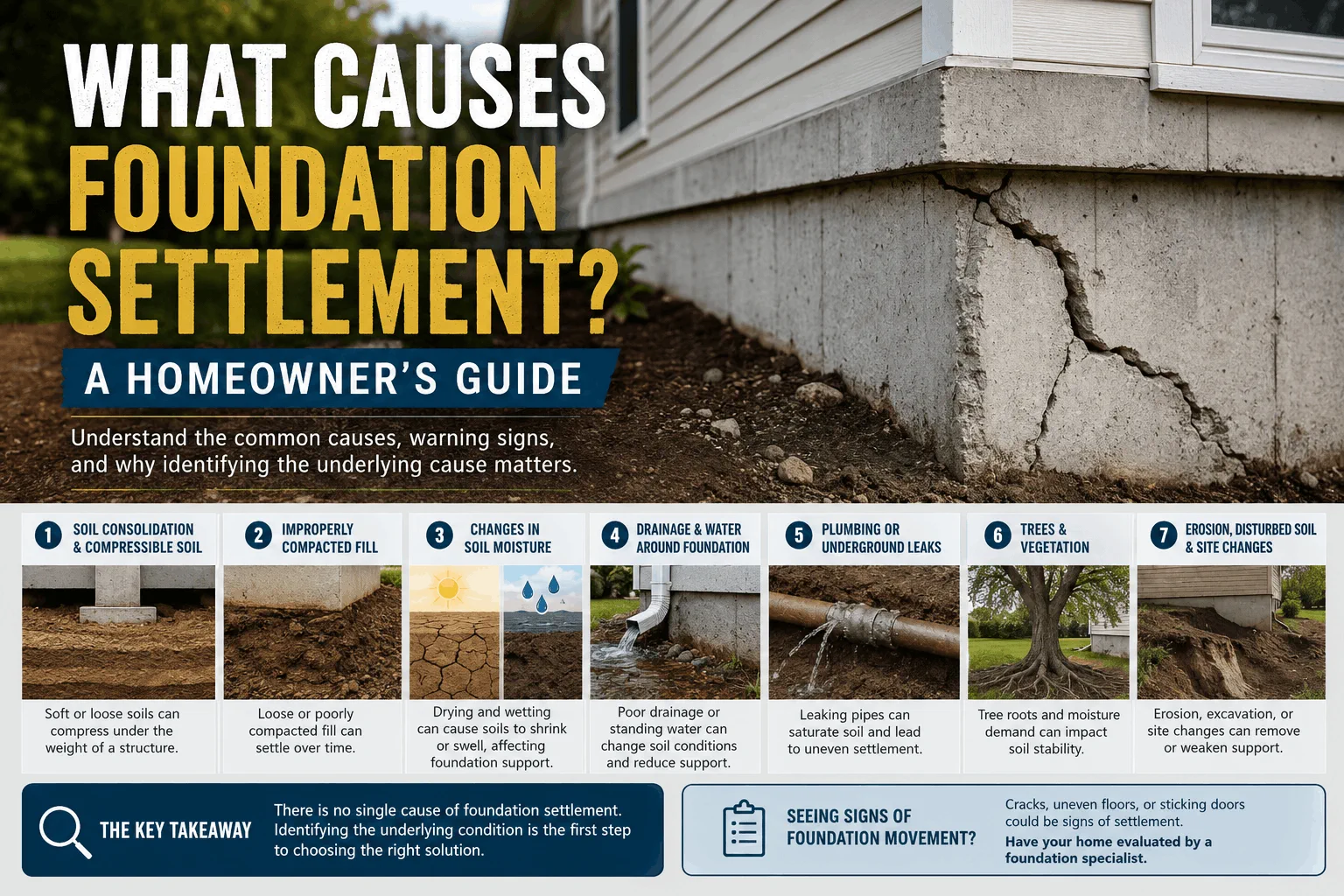
A new foundation crack, sticking door, or uneven area of flooring can make you wonder whether your house is moving and, more importantly, why.
There is no single explanation that applies to every home. Foundation settlement causes can involve the soil beneath the house, changes in moisture, site preparation, drainage, or a combination of conditions. The Federal Highway Administration’s geotechnical guidance identifies soft or loose foundation soils as conditions that can contribute to long-term settlement under load.
That is why identifying the underlying condition matters. A visible crack or uneven floor may be worth investigating, but the symptom alone does not tell you what is happening below the foundation or what type of repair, if any, is appropriate.
What Is Foundation Settlement?
Foundation settlement is downward movement that occurs when the soil or other supporting material beneath a foundation changes or compresses.
A home’s foundation transfers its weight into the ground below it. If that supporting material compresses, loses volume, or otherwise changes, part or all of the foundation may move downward.
Some soils are more susceptible to compression than others. FHWA guidance notes that soft, loose, and highly compressible soils can experience settlement and deformation when subjected to loads.
Not all settlement happens in the same way.
Uniform vs. Differential Settlement
Uniform settlement occurs when a structure moves downward relatively evenly.
Differential settlement occurs when one portion of the foundation moves more than another.
For homeowners, differential movement can be more noticeable because different sections of the structure are no longer moving together. Cracks, gaps, floor changes, or misaligned openings may appear, although these observations alone do not establish the cause.
If you are trying to distinguish ordinary movement from conditions that may deserve closer attention, see our guide to house settling vs. foundation problems.
What Causes Foundation Settlement?
Several conditions can change the support beneath a foundation. Sometimes one factor dominates. In other cases, several conditions may be interacting.
Here are seven foundation settlement causes homeowners should understand.
1. Soil Consolidation and Compressible Soil
Some soils compress more readily than others.
When a structure places weight on soft or loose soil, that soil can gradually compress. FHWA identifies poor ground conditions, including soft or loose foundation soils, as conditions that can produce long-term settlement under load. Read the FHWA guidance on poor ground conditions and settlement.
How much movement occurs depends on factors such as:
- the soil profile
- soil density and compressibility
- groundwater conditions
- the depth of weaker soil layers
- loads being transferred into the ground
This is why it can be misleading to say that every house simply “settles with age.” The amount, location, pattern, and underlying cause of movement all matter.
2. Improperly Compacted Fill
Not every foundation is constructed entirely over undisturbed natural soil. Construction sites may contain areas of placed fill used to establish the required grade.
Proper compaction makes soil denser and less compressible. According to the Federal Highway Administration’s guidance on soil compaction, compaction can decrease soil compressibility and reduce the potential for excessive long-term settlement.
If supporting fill is loose or inadequately compacted, it may continue compressing after construction. Uneven conditions beneath different portions of the foundation can also contribute to uneven movement.
However, visible settlement does not prove that improper construction caused the problem. The home’s original site preparation may be unknown, and several other conditions can create similar symptoms.
3. Changes in Soil Moisture
Moisture can significantly affect certain types of soil.
The U.S. Geological Survey defines expansive soils as soils that shrink as moisture content decreases and swell as moisture content increases. Structures supported on these soils can experience movement as the soil changes volume.
This distinction is important because moisture-related foundation movement does not always mean settlement.
When moisture-sensitive soil loses water and shrinks, the resulting change in soil volume may contribute to a reduction in support beneath portions of a foundation.
When moisture-sensitive soil absorbs water and expands, the soil may instead move upward. That type of movement is generally referred to as heave, rather than settlement.
In simple terms:
- Drying can cause some moisture-sensitive soils to shrink.
- Wetting can cause some moisture-sensitive soils to swell.
- The effect depends on the soil and conditions at the individual property.
A period of wet or dry weather by itself cannot tell you exactly what is happening beneath a particular home.
4. Drainage and Concentrated Water Around the Foundation
Water around a home can affect more than whether a basement feels damp.
Changes in groundwater, saturation, drainage, and soil moisture can influence how certain supporting soils behave. FHWA’s guidance on compressible soils and subsurface moisture conditions discusses the importance of soil and groundwater conditions when evaluating ground performance.
Conditions worth paying attention to may include:
- concentrated roof runoff
- persistent wet areas near the foundation
- drainage directed toward the house
- changes in grading
- erosion around portions of the property
- recurring water accumulation
That does not mean every drainage problem causes foundation settlement. Drainage is one possible piece of the larger site picture.
If water is also entering your basement, Crack Wizard’s basement waterproofing services address water intrusion, drainage systems, sump pumps, and related basement moisture concerns.
5. Plumbing or Underground Water Leaks
Rainfall is not the only possible source of changing soil moisture.
A plumbing or underground water leak near a foundation can create localized moisture conditions that differ from the surrounding soil.
Whether that affects foundation support depends on factors such as:
- where the water is located
- how long the condition has existed
- the type of soil
- drainage
- foundation construction
- where the water travels below ground
A leak should therefore not automatically be labeled the cause of foundation settlement.
Finding the water source and understanding the pattern of foundation movement are separate parts of determining what may be happening.
6. Trees and Vegetation
Trees near houses are frequently blamed for foundation problems, but the relationship is more complicated than roots simply pushing a foundation downward.
Vegetation can influence soil moisture. Where moisture-sensitive soils are present, changes in water content can contribute to changes in soil volume.
The important point is that a nearby tree does not automatically mean the tree caused foundation settlement.
Factors that can matter include:
- soil type
- tree species and size
- distance from the home
- root distribution
- rainfall and drought conditions
- drainage
- foundation depth and design
Tree removal should not be treated as a universal foundation repair strategy without understanding the conditions at the property.
7. Erosion, Disturbed Soil, and Other Site Changes
The supporting ground around a home can also change because of activity on the property.
Potential contributing conditions can include:
- erosion
- excavation near the structure
- disturbed fill
- significant grading changes
- drainage alterations
- construction additions
- other changes that affect the supporting soil
Geotechnical evaluations consider factors such as soil strength, compressibility, groundwater, and the extent of weaker soil layers because subsurface conditions can vary considerably even across relatively small areas. FHWA’s geotechnical guidance explains these site considerations in more detail.
This is one reason two homes with similar-looking cracks can have very different underlying conditions.
Why Differential Settlement Can Create More Noticeable Problems
A foundation that moves unevenly can transfer stress into other parts of the structure.
Depending on the construction and the amount and location of movement, homeowners may notice:
- foundation or wall cracks
- separation around doors or windows
- doors or windows that begin sticking
- changes in floor elevation
- gaps between building components
- cracking in exterior masonry
These observations can be associated with foundation movement, but they are not proof of a particular structural condition.
If you are seeing several changes around your home, our guide to the warning signs of foundation problems explains what homeowners can document and when further evaluation may make sense.
The important distinction is between a symptom and a diagnosis.
A crack tells you that a material has cracked. It does not, by itself, explain why.
Does St. Louis Soil Cause Foundation Settlement?
Soil can be part of the equation, but living in St. Louis does not by itself tell you why a particular foundation is moving.
Soil conditions may vary from property to property, along with:
- previous grading
- fill placement
- drainage
- vegetation
- groundwater conditions
- foundation construction
- previous modifications to the property
The USDA Natural Resources Conservation Service provides the Web Soil Survey, which allows users to explore mapped soil information for locations across the country. Mapped soil information can provide useful background, but individual engineering applications may still require site-specific investigation.
Missouri also experiences changing soil-moisture conditions. The Missouri Department of Natural Resources operates a Soil Moisture Monitoring and Mapping Initiative that collects soil-moisture and temperature information across the state.
That regional information can provide useful context, but it cannot diagnose an individual foundation.
The practical takeaway for St. Louis homeowners is simple:
Location alone cannot tell you why your foundation is moving. The conditions at the individual property matter.
How Is the Cause of Foundation Settlement Determined?
Determining why a foundation appears to be moving usually requires looking beyond a single crack.
Depending on the property and the concerns involved, an evaluation may consider:
- where cracks and separations are located
- whether conditions appear to be changing
- whether several symptoms occur in the same area
- floor or foundation elevations when appropriate
- exterior grading
- drainage patterns
- foundation construction
- signs of water intrusion
- plumbing or other nearby water sources
- previous repairs
- additions or property modifications
- surrounding vegetation
- available information about supporting soils
The key principle is:
The visible symptom and the underlying cause are not necessarily the same thing.
Repairing a crack, for example, addresses the crack. It does not automatically prove why the crack developed.
If a foundation or basement crack is the primary concern, Crack Wizard’s foundation crack repair page explains the crack repair services available for St. Louis-area homes.
When the concern involves settlement, wall movement, or another broader structural condition, learn more about foundation repair in St. Louis.
Can Foundation Settlement Be Prevented?
Homeowners cannot control every soil, construction, or subsurface condition beneath a property.
However, reasonable property maintenance can help reduce some avoidable changes around a foundation.
Depending on the home, that may include:
- correcting known plumbing leaks
- watching for persistent water accumulation
- maintaining appropriate drainage paths
- avoiding concentrated water discharge immediately beside the foundation
- watching for new or changing cracks
- documenting noticeable changes over time
- having unexplained or progressive movement evaluated
Be cautious with generic advice that recommends adding water around every foundation on a fixed schedule.
Because moisture affects soils differently, particularly where shrink-swell soils are involved, there is no single moisture-management rule that is appropriate for every property. The USGS explanation of expansive soils illustrates why both drying and wetting can produce ground movement in susceptible soils.
When Should You Have Foundation Movement Evaluated?
One isolated symptom may provide limited information. An evaluation can become more useful when changes are new, progressive, recurring, or appearing together.
Examples may include:
- cracks that appear to be changing
- several new cracks or separations
- noticeable changes in floor elevation
- multiple doors or windows becoming difficult to operate
- gaps developing between building components
- cracks repeatedly reopening after cosmetic repair
- visible displacement
- several symptoms developing in the same portion of the home
These are reasons to investigate further, not proof that structural foundation repair is required.
For a more detailed symptom checklist, see 10 Warning Signs of Foundation Problems in Your Home.
Foundation Settlement Starts With the Conditions Below the Home
There is no single cause of foundation settlement that applies to every house.
Compressible soil, fill conditions, moisture changes, drainage, water sources, vegetation, erosion, and other site conditions can all affect how the ground supports a foundation.
The important step is determining why the movement is occurring before deciding what should be done about it.
If you are noticing cracks, uneven movement, or other changes around your St. Louis-area home, Crack Wizard provides foundation repair services in St. Louis for settlement and related foundation concerns. An evaluation can help determine what conditions are present and what next steps may be appropriate.
Frequently Asked Questions
What is the most common cause of foundation settlement?
There is no single cause that applies to every property. Foundation settlement can involve compressible soil, loose fill, moisture changes, drainage conditions, or other site-specific factors. Identifying the cause requires evaluating the property rather than relying on one visible symptom.
Can dry soil cause a foundation to settle?
Under certain conditions, yes. Some moisture-sensitive soils shrink when they lose water. If the resulting soil-volume change reduces support beneath part of a foundation, downward movement may occur. The USGS provides additional information about shrink-swell soils.
Can too much water cause foundation settlement?
Water can influence supporting soil conditions, but the result depends on the soil and site. Some soils swell when moisture increases, while other water-related conditions can affect soil strength, erosion, or support. Water should be considered as part of the overall investigation rather than automatically identified as the cause.
What is differential foundation settlement?
Differential settlement occurs when one portion of a foundation moves more than another. Uneven movement may correspond with cracks, gaps, floor changes, or changes around doors and windows, although these symptoms need to be interpreted in context.
Can trees contribute to foundation settlement?
Trees can influence moisture conditions in surrounding soil. Where moisture-sensitive soils are present, those changes may affect soil volume. A nearby tree alone does not prove that the tree caused foundation movement.
How do you determine what is causing a foundation to settle?
An evaluation may consider the movement pattern, foundation construction, grading, drainage, water sources, property history, vegetation, and supporting soil conditions. Looking at several pieces of evidence is more useful than diagnosing a foundation from a crack or other isolated symptom.