
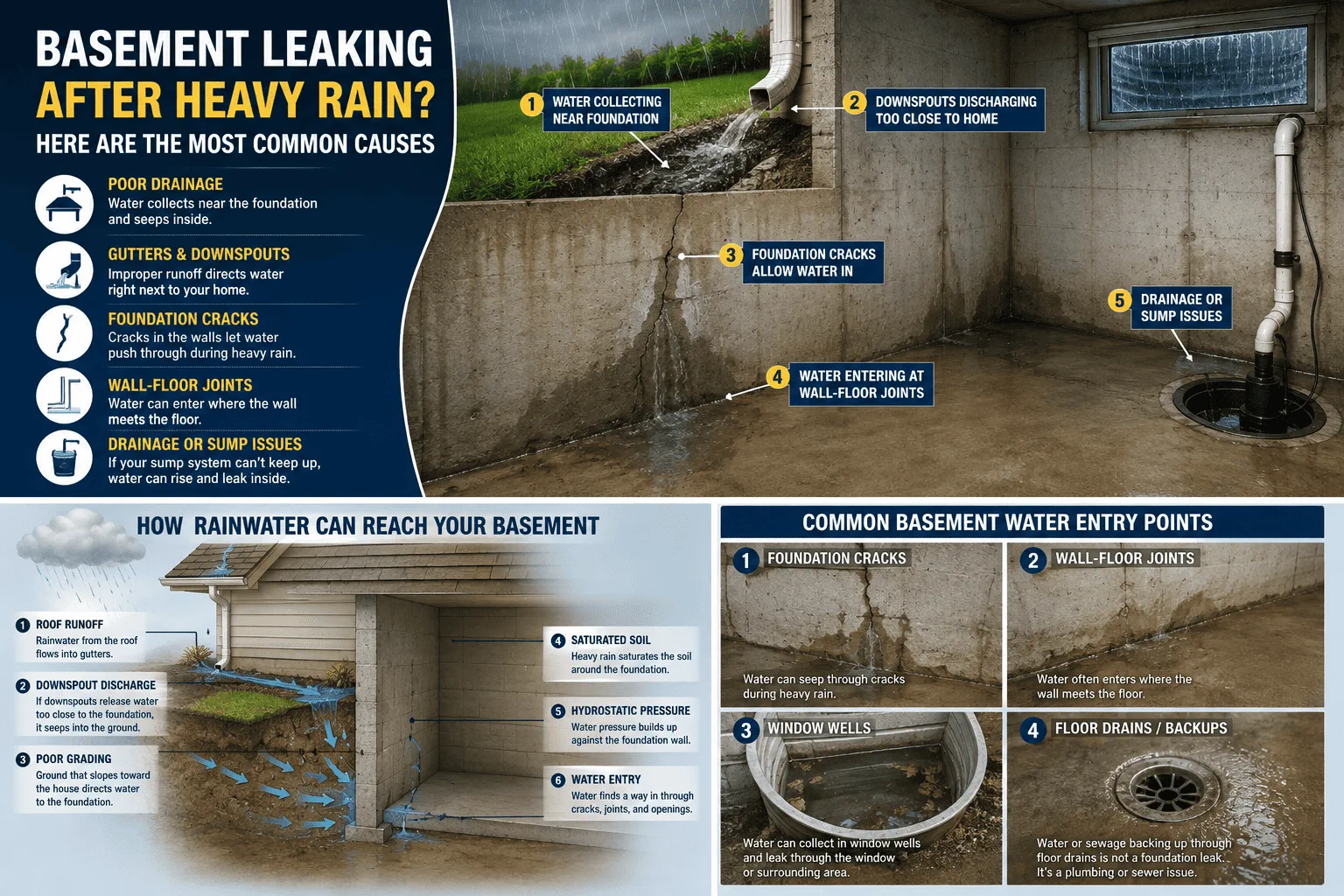
If your basement is leaking after heavy rain, the storm may be exposing a drainage or water-entry problem that is difficult to notice during dry weather.
Heavy rainfall puts more water around a home. Roof runoff, surface drainage, rain-soaked soil, and groundwater can all increase the amount of moisture that the foundation and drainage systems need to manage. The U.S. Environmental Protection Agency notes that foundations are exposed to surface water, rain-soaked soil, and potentially groundwater, which is why controlling water around a foundation is an important part of moisture management.
That does not mean every wet basement has the same cause. Water might be entering through a foundation crack, along the wall-floor joint, around a basement window, or through another opening. In other cases, what appears to be a basement leak may actually involve a sewer or drainage backup.
Finding the source is the first step toward choosing an appropriate solution.
Why Can Heavy Rain Make a Basement Start Leaking?
A basement can remain dry through ordinary rainfall but develop water problems during a heavier storm because much more water is reaching the property at once.
There are two broad areas to consider:
- Water above ground, including roof runoff and surface water
- Water in the soil, including rainwater that has soaked into the ground and groundwater around or beneath the foundation
Proper drainage helps limit the amount of water that accumulates against a foundation. Building-science guidance recommends directing roof runoff away from the house, sloping the ground away from the foundation, and using foundation drainage systems to manage subsurface water.
If water builds up around or beneath a basement, it can create hydrostatic pressure. In simple terms, this is pressure created by accumulated water. That pressure can encourage water to move through available cracks, joints, penetrations, or other imperfections in the foundation.
Heavy rain therefore may not create the underlying weakness. Instead, it can reveal a water-management problem or entry pathway that was already present.
7 Common Ways Water Gets Into a Basement After Heavy Rain
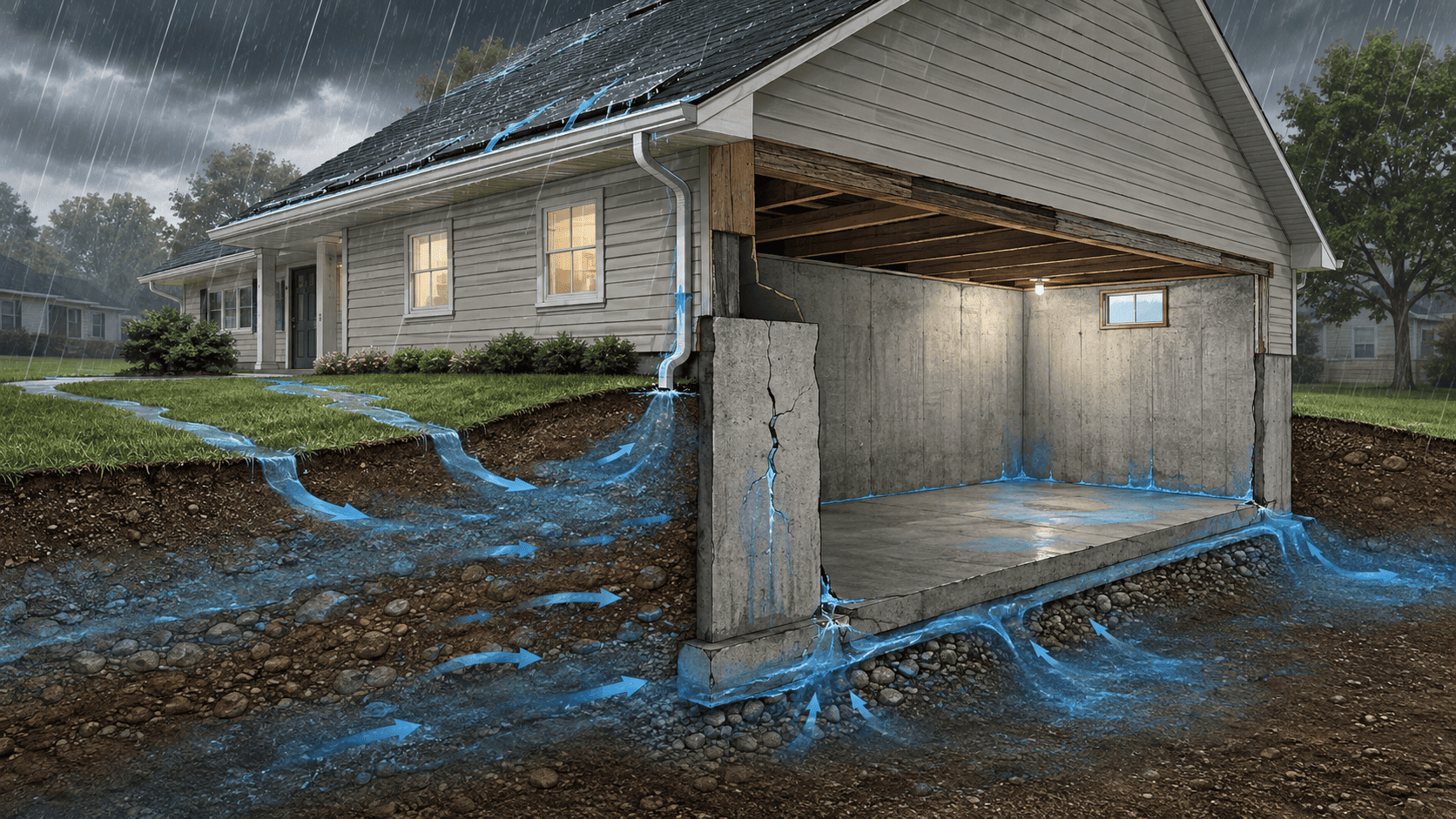
1. Water Is Collecting Near the Foundation
Start by looking at what happens outside the home during and immediately after rainfall.
If the ground directs water toward the house rather than away from it, more water can collect beside the foundation. Low spots near the home can create a similar problem.
EPA moisture-control guidance recommends directing surface water away from foundations, while DOE-backed building-science guidance similarly emphasizes grading and drainage that move rainwater away from the building.
Signs worth observing include:
- Puddles beside the foundation
- Water flowing toward the house
- Soil staying saturated near one part of the basement
- Basement leakage corresponding with the same exterior location
These observations can help narrow down the source, but they do not by themselves identify the correct repair.
2. Gutters or Downspouts Are Concentrating Water Near the House
A roof collects a large amount of rainwater during a storm. Gutters and downspouts are intended to collect that water and direct it away from vulnerable areas around the foundation.
Problems can occur when:
- Gutters overflow
- Downspouts become disconnected
- Downspouts discharge immediately beside the house
- Roof runoff repeatedly concentrates in one location
- Drainage pathways send discharged water back toward the foundation
The EPA specifically identifies redirecting downspout runoff away from foundations as one potential way to address basement moisture problems.
Checking roof drainage is therefore a sensible early step when a basement leaks primarily during storms.
3. Water Is Entering Through a Foundation Crack
A visible crack in a basement wall can provide a pathway for water under wet conditions.
You may notice:
- Moisture directly along the crack
- A darkened area on the concrete
- Water droplets forming on the crack
- A small stream of water during heavier rainfall
- Mineral deposits around an area that has previously been wet
The important distinction is that a leaking crack is not automatically proof of a serious structural problem. Foundation cracks can develop for different reasons, and their significance depends on factors such as location, pattern, movement, surrounding conditions, and other signs elsewhere in the home.
If the water consistently appears through a visible crack, the crack and surrounding conditions should be evaluated rather than simply assuming the surface opening tells the entire story.
Crack Wizard provides foundation crack repair in St. Louis, including evaluation of cracks and the conditions associated with them.
4. Water Is Appearing Where the Wall Meets the Floor
Homeowners sometimes notice water along the perimeter of the basement rather than running down the middle of a wall.
The joint where a basement wall meets the floor slab can become a visible water-entry area when subsurface water accumulates around or beneath the foundation. Building Science Corporation notes that accumulated groundwater can create hydrostatic pressure that pushes water through available joints, cracks, and imperfections.
This can look like:
- A wet line along one basement wall
- Water appearing along several feet of the perimeter
- Small puddles forming near the base of a wall
- Water becoming noticeable only after prolonged or intense rainfall
The appropriate response depends on why water is reaching that location. Interior drainage, exterior drainage, sump systems, or other waterproofing approaches may be considered depending on the conditions found during an evaluation.
5. Water Is Coming Through the Floor or Other Penetrations
Some homeowners notice moisture around a floor crack, pipe penetration, utility opening, or another break in the basement floor or wall.
Water beneath a basement slab needs somewhere to go. If drainage is inadequate and water accumulates beneath the slab, available cracks or penetrations may become visible pathways.
This is another reason why simply sealing the first wet spot you see may not always address the underlying water-management issue.
Pay attention to where the moisture first becomes visible and whether the same location becomes wet during repeated storms.
6. A Basement Window or Window Well Is Allowing Water In
Below-grade basement windows and window wells are another area to inspect after heavy rain.
If stormwater collects in a window well faster than it can drain away, water may reach vulnerable areas around the window frame or opening.
Possible clues include:
- Standing water in a window well
- Water stains beneath a basement window
- Dampness concentrated around the window frame
- Debris interfering with drainage
- Leakage that starts near a window before spreading across the floor
The source may involve exterior drainage, the window well, the window installation, or a combination of conditions. The visible leak should be evaluated in context rather than assuming the window itself is the only problem.
7. The Drainage or Sump System Is Not Managing the Incoming Water
A basement drainage system may see its highest workload during a prolonged or intense rain.
A sump pump that runs frequently during a storm is not automatically defective. Its job is to remove collected water. However, conditions worth investigating include:
- The sump pit filling without the pump activating
- Water rising faster than it is being removed
- The pump cycling abnormally
- Water appearing elsewhere despite the system operating
- A power interruption affecting the pump
- Recurring basement water even though a drainage system is installed
These situations may indicate that part of the drainage or sump system needs evaluation.
Crack Wizard’s verified basement waterproofing services in St. Louis include interior drainage, sump pump systems, exterior waterproofing, and wall encapsulation. The appropriate system depends on the source and pathway of the water.
Where Is the Water Showing Up? Use the Location as a Clue
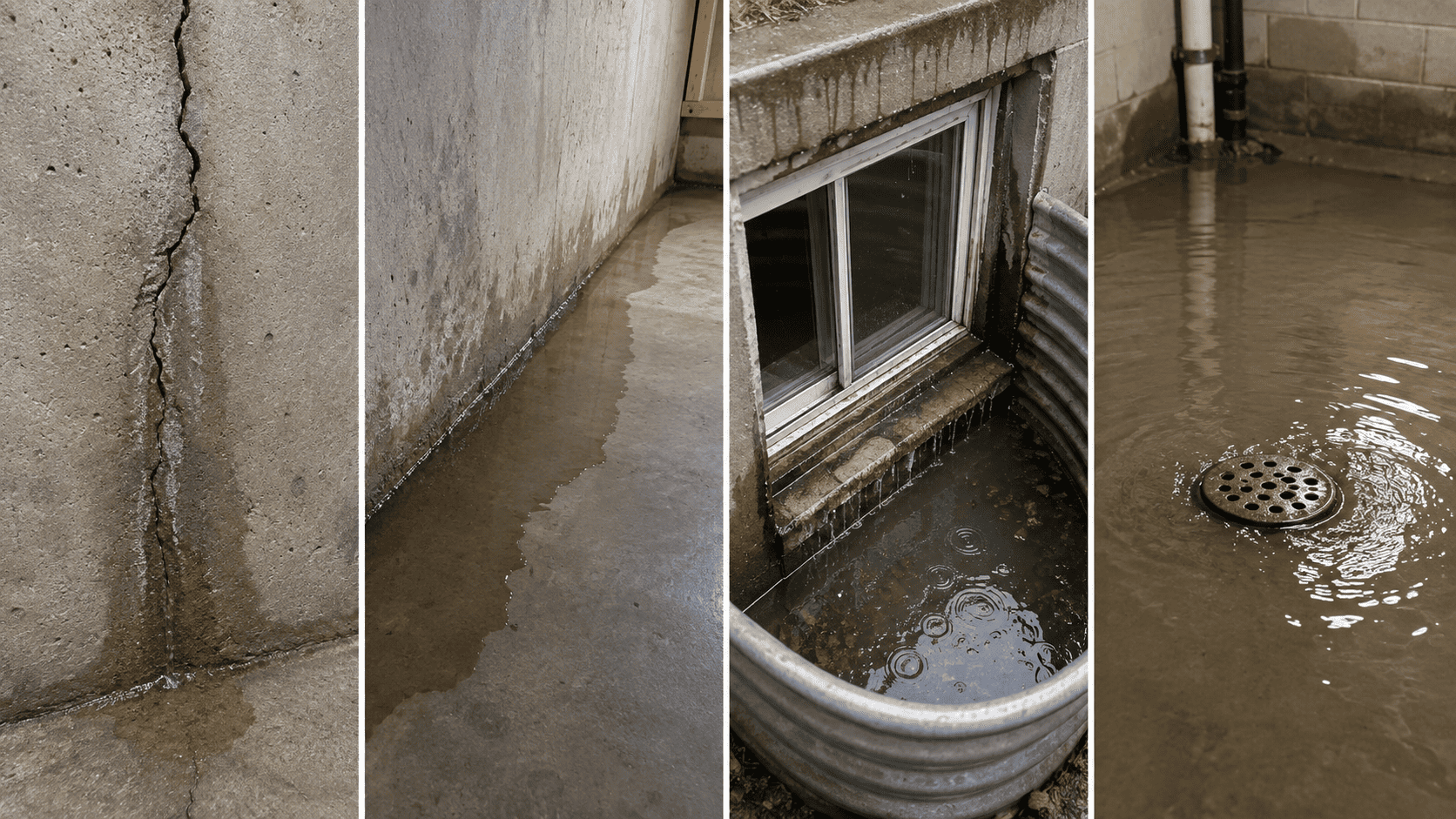
The location where water first appears can provide useful clues about what should be investigated.
| Where You First Notice Water | Possible Condition to Investigate |
|---|---|
| Directly through a visible wall crack | Crack acting as a water-entry pathway |
| Along the wall-floor perimeter | Water accumulating around or beneath the foundation |
| Beneath a basement window | Window well, exterior drainage, or window-opening issue |
| Around a pipe or wall penetration | Opening or sealing issue around the penetration |
| At a floor crack | Moisture or groundwater conditions beneath the slab |
| Around the sump pit | Sump pump or drainage-system performance |
| From a floor drain or plumbing fixture | Possible plumbing or sewer backup |
This table is a starting point, not a diagnosis. Water can travel behind finishes, along concrete surfaces, or beneath flooring before becoming visible, so the first puddle you find is not always the exact point where the water entered.
Could It Be a Sewer Backup Instead of a Foundation Leak?
This distinction is particularly important for homeowners in the St. Louis area.
Water entering through a foundation crack or window is not the same problem as wastewater backing up through a floor drain or plumbing fixture.
MSD Project Clear states that building backups are most likely to occur during heavy rainfall, although many backups involve issues with private plumbing rather than failure of the public sewer system.
MSD also specifically distinguishes overland flooding, where stormwater enters through doors, windows, or foundation cracks following heavy rain, from a building sewer backup.
St. Louis also has different types of sewer infrastructure. MSD explains that St. Louis City and some older inner suburbs use combined sewers that carry wastewater and stormwater, while separate sanitary and stormwater systems predominate throughout much of its St. Louis County service area. Heavy wet-weather events can place additional demands on these systems.
If water or sewage is coming up through a floor drain or plumbing fixture, contact the appropriate sewer or plumbing professional rather than assuming the foundation is leaking. MSD advises customers within its service area to report sewage backing into a building through a floor drain.
Important safety note
Do not enter standing water if it has reached an electrical outlet, extension cord, appliance connection, or other electrical source. MSD also warns that sewage and floodwater can contain harmful contaminants.
What Should You Check After a Heavy Rain?
Once conditions are safe, take a systematic look at the basement and the exterior.
Inside the basement
Check:
- Where did the water first appear?
- Is there a visible crack at that location?
- Is water coming down the wall or appearing at floor level?
- Is the leak below a basement window?
- Is moisture appearing around a pipe or other penetration?
- Is the sump pump operating?
- Is water coming from a floor drain or plumbing fixture?
- Are there previous water stains or mineral deposits nearby?
Photographs taken while the leak is active can also be useful because some evidence disappears once the basement dries.
Outside the home
Look for:
- Gutters overflowing during rain
- Disconnected or damaged downspouts
- Downspouts releasing water beside the foundation
- Water collecting near the house
- Ground that appears to direct runoff toward the foundation
- Standing water in window wells
- Concentrated roof or surface runoff near the same location as the interior leak
Avoid excavation or major DIY repairs until you understand the likely source. The goal at this stage is observation.
What Can Help Prevent Future Rain-Related Basement Water?
The right solution depends on the pathway that is allowing water into the basement.
Improve surface drainage where needed
Keeping rainwater away from the foundation is one of the basic principles of foundation moisture control. Gutters, downspouts, grading, and surface drainage should work together to direct water away from the building.
Address leaking cracks appropriately
If water repeatedly enters through the same foundation crack, the crack should be evaluated to determine both how it should be repaired and whether there are other conditions that need attention.
The appearance of a crack alone should not be used to diagnose a structural problem.
Manage water around or beneath the foundation
Where groundwater or subsurface water is contributing to recurring leakage, a drainage system may be necessary to collect and redirect that water.
Depending on the home and source of the leak, solutions may involve interior drainage, sump systems, exterior waterproofing, or another drainage approach. There is no single waterproofing method that is correct for every wet basement.
Correct window-well or opening problems
If water consistently enters around a window or another below-grade opening, drainage around that opening should be inspected along with the surrounding grade and water flow.
Evaluate an existing sump system
A sump system that does not activate, cannot manage incoming water, or repeatedly coincides with basement flooding should be evaluated rather than relying on temporary cleanup after each storm.
When Should You Have the Basement Evaluated?
Consider professional evaluation when:
- The basement leaks during multiple storms
- You cannot identify where the water is entering
- Water repeatedly comes through a foundation crack
- Leakage occurs along a significant portion of the basement perimeter
- The sump or drainage system does not appear to control incoming water
- Water is appearing through the floor
- You notice a bowing or leaning wall
- Cracks appear to be changing
- Doors, floors, or other areas of the home show possible movement along with foundation cracking
- You are planning to finish a basement that has a history of moisture
EPA guidance recommends correcting basement moisture problems before converting basement space into finished living space.
If cracking is accompanied by wall movement or other signs that may be associated with foundation movement, a broader foundation evaluation may be appropriate. Crack Wizard also provides foundation repair services in St. Louis.
Basement Leaking After Heavy Rain in St. Louis?
A wet basement does not automatically tell you why water is getting inside.
Heavy rain can reveal problems with surface drainage, foundation cracks, wall-floor joints, basement windows, sump systems, subsurface drainage, or other openings. In some situations, water coming through a floor drain may involve a sewer or plumbing problem instead.
The useful first step is to identify where the water is coming from and what conditions are allowing it to reach that point.
Crack Wizard provides basement waterproofing and foundation crack repair for homeowners in the St. Louis area. If your basement repeatedly takes on water during or after heavy rain, request an inspection to determine the likely entry pathway and which repair or waterproofing approach fits the conditions in your home.
Frequently Asked Questions
Why does my basement leak only during heavy rain?
Heavy rain places a larger water load around your home than normal rainfall. Surface runoff, roof drainage, saturated soil, and groundwater can expose cracks, joints, drainage weaknesses, or other openings that remain dry under ordinary conditions.
Does water in my basement mean I have foundation damage?
Not necessarily. Water can enter through cracks and foundation joints without proving that the foundation has a structural problem. The crack pattern, movement, surrounding conditions, and other symptoms should be considered before reaching a structural conclusion.
Can gutters cause a basement to leak?
Gutters themselves do not cause foundation leaks, but poorly managed roof runoff can concentrate a substantial amount of water beside the foundation. Redirecting downspout runoff away from the home is one of the moisture-control measures recommended by the EPA.
Why is water coming in where the basement wall meets the floor?
Water appearing at the wall-floor joint can be associated with water accumulating around or beneath the foundation. Subsurface drainage conditions should be evaluated to determine why the water is reaching that location.
Will waterproofing paint stop basement water?
A surface coating may not address water pressure, drainage conditions, or a leaking joint behind it. Recurring leakage should be traced to its source before deciding which repair method is appropriate.
How can I tell whether I have a sewer backup?
Water or sewage rising from a floor drain or plumbing fixture is different from rainwater entering through a wall crack or window. Within MSD’s service area, sewage backing into a building through a floor drain should be reported to MSD.