
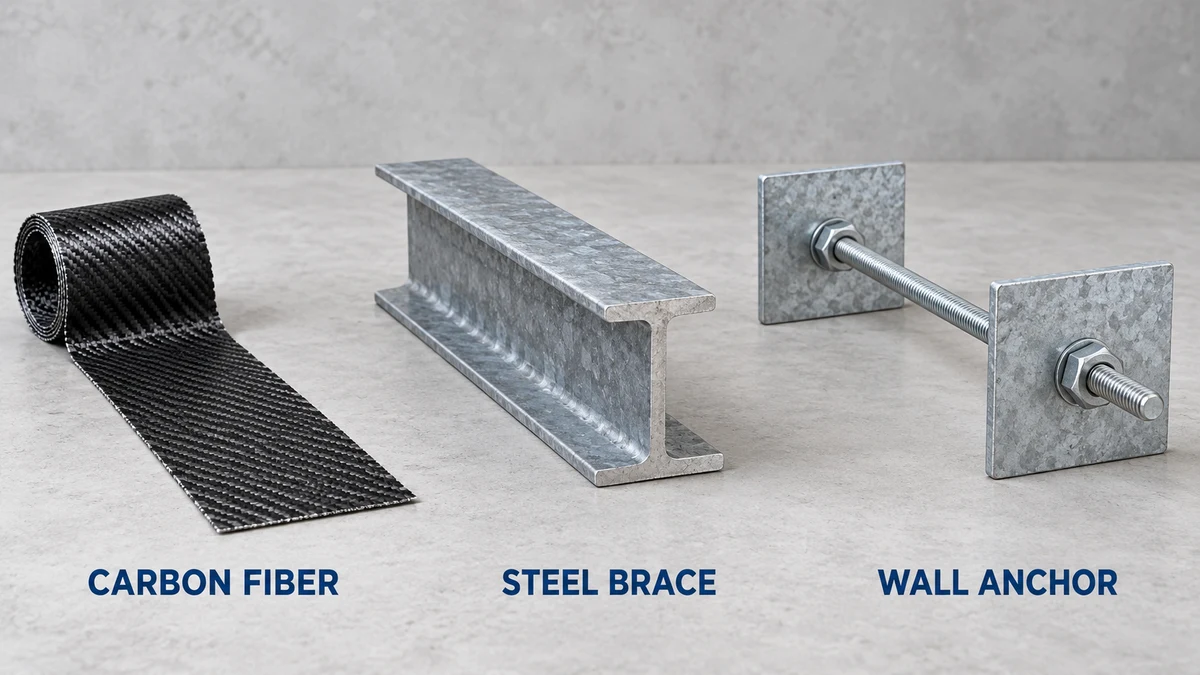
Comparing carbon fiber vs wall anchors can feel like choosing between two completely different answers to the same problem. Both may be proposed for an inward-moving basement wall, but they resist movement in different ways. Interior steel braces and, in some cases, wall reconstruction belong in the conversation too.
For a St. Louis-area homeowner, the useful question is not which material wins a strength contest. It is which repair creates a dependable support system for this particular wall, its remaining condition, and the pressures acting on it. Here is how to compare the options without treating a product brochure as a diagnosis.
Start With the Wall, Not the Repair Product
A wall that bows through its middle is different from one that tilts at the top, slides near its base, or breaks apart along deteriorated masonry joints. Those conditions can also occur together. The evaluator needs to understand the movement pattern, wall material, cracking, supporting connections, and any foundation settlement before recommending reinforcement.
Ask whether the proposal is intended to stabilize the wall in its present position, attempt controlled straightening, or replace damaged construction. These are different objectives. No photograph, crack width, or single measurement provides a universal pass-or-fail test for every system. New or increasing movement deserves prompt professional assessment rather than waiting for a preferred product to become suitable.
Carbon Fiber: Reinforcement Bonded to the Wall
Carbon-fiber reinforcement commonly uses thin strips or fabric bonded to the interior wall with a specified resin system. It adds tensile reinforcement: resistance to stretching as the wall bends. Its small profile can be useful where preserving interior space matters.
The bond is part of the structure. Sound wall material, appropriate preparation, compatible resin, and the design of the strip terminations all matter. A strong fabric cannot compensate for an unsuitable surface or an incomplete support path. Required connections and suitable wall types vary by system.
Carbon fiber should not be assumed to pull an already bowed wall straight. Rhino Carbon Fiber’s technical questions about wall reinforcement distinguish strengthening from restoring a wall’s original position and emphasize that suitability has no single universal deflection limit. That is a manufacturer’s explanation of its products, not a claim that Crack Wizard installs that brand.
The practical trade-off is a low-profile reinforcement approach whose success depends on the existing wall and the complete design. Ask what makes your wall a candidate and what condition would rule it out.
Steel Braces: Interior Members With Structural Connections
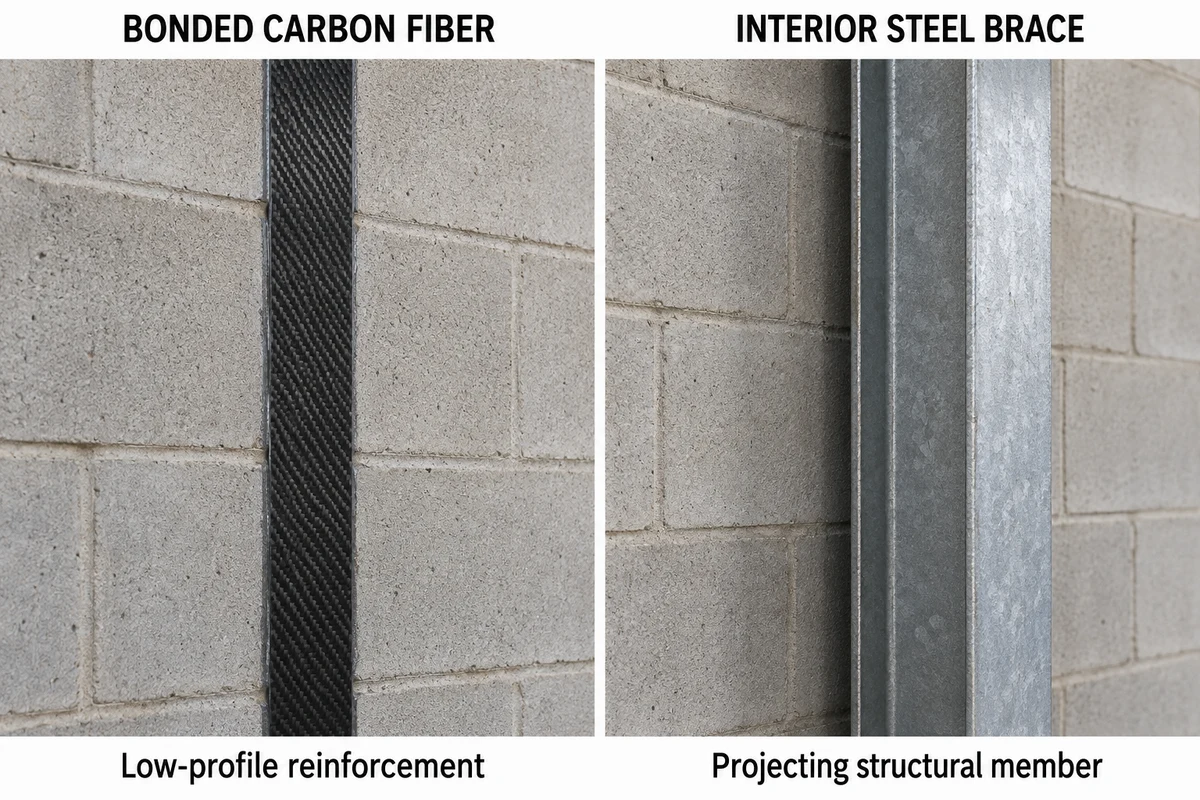
Interior bracing typically places vertical steel members against the basement wall. Instead of relying mainly on a thin bonded reinforcement layer, the braces resist wall movement through the members and their connections to suitable supporting construction.
For example, Supportworks’ descriptions of foundation repair systems show one steel-brace design connected to the basement floor and first-floor framing. That arrangement illustrates why the receiving structure matters; it is not a universal detail for every brace or house. Joist direction, framing condition, and the available base support need review.
Steel members project farther into the room than bonded fabric, which can affect shelving, utilities, and future basement finishing. Interior systems may avoid the yard access needed for earth anchors. Some designs allow professionally controlled adjustment, but a proposal should state whether straightening is appropriate and what result is realistic. Never tighten or modify a brace yourself.
Wall Anchors and Tiebacks: Transferring Force Into Soil
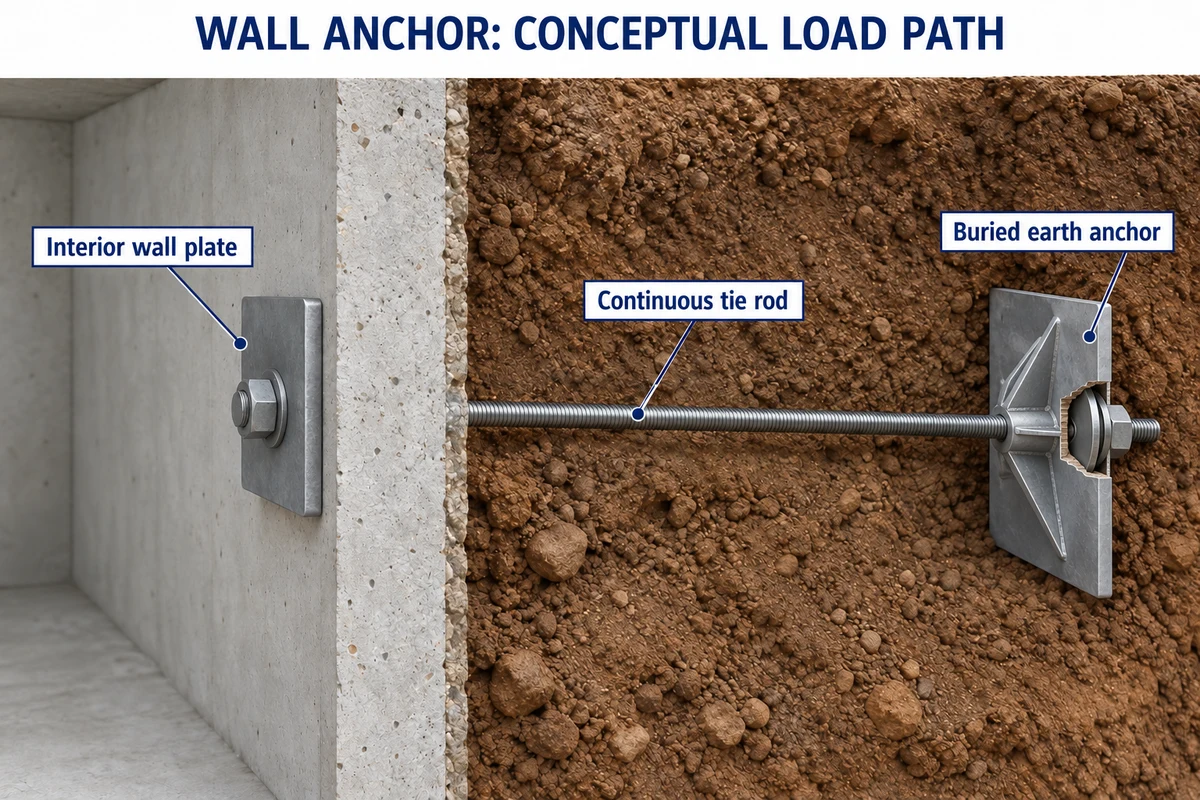
A plate-anchor system connects a bearing plate on the inside of the wall to an earth anchor beyond the wall through a steel rod. The anchor relies on suitable soil resistance at its designed location. Earth Contact Products’ plate-anchor explanation describes these three components: interior plate, connecting rod, and exterior earth plate.
Helical tiebacks use a different anchor configuration, with helical plates advanced into soil. They should not be treated as identical to excavated plate anchors. For either approach, ask how the design establishes adequate anchorage and transfers force through the wall without overstressing damaged material.
Outdoor access can be a deciding factor. Property boundaries, buried utilities, nearby structures, landscaping, and available working space may limit a proposed layout. The contractor should explain access and restoration needs before work begins. Some systems can be adjusted as part of an engineered repair plan, but full straightening is not an automatic outcome.
When Reinforcement Alone May Not Be Enough
If the wall is severely displaced, extensively deteriorated, or unable to carry and transfer the required loads, adding strips, braces, or anchors may not adequately address the problem. A structural engineer may recommend partial or full reconstruction, or another designed structural solution.
Reconstruction can involve excavation, temporary support, rebuilding, and restoring adjacent finishes or landscaping. Its scope should be compared with a complete stabilization proposal, not with the price of reinforcement materials alone. Conversely, a visible bow does not by itself prove that replacement is necessary. Ask for the condition-based reasoning behind either recommendation.
Compare the Complete Scope, Not a Per-Strap Price
When reviewing carbon fiber vs wall anchors or steel bracing, request proposals that answer the same questions:
- What is the documented problem? Look for wall measurements, movement patterns, and an explanation of the likely contributing conditions.
- Where do the forces go? The design should identify the wall, framing, base support, or soil that receives the transferred load.
- What is included? Compare engineering, required permits, access work, crack treatment, drainage work, cleanup, and restoration.
- What happens afterward? Ask about inspections, monitoring, adjustment responsibilities, accessible components, and written warranty limits.
A lower initial quote may describe a different repair objective or exclude work another quote includes. There is no reliable universal cost ranking without matching the wall condition and scope. Keep the assessment, drawings, installation records, and follow-up requirements together for future maintenance and potential resale questions.
Water and Cracks Still Need Their Own Plan
Wall stabilization does not automatically solve basement leakage. Surface runoff, groundwater, plumbing leaks, and other moisture sources need evaluation alongside the structural work. St. Louis and Midwest weather makes it useful to record whether changes follow heavy rain or seasonal conditions without assuming weather explains every crack.
Discuss basement waterproofing options when water entry is part of the problem. Likewise, foundation crack repair may address a specific crack or leak, but filling a crack is not a substitute for the support required by a moving wall. Coordinate the scopes so one repair does not interfere with another.
Frequently Asked Questions
Is carbon fiber better than wall anchors for every basement wall?
No. Carbon fiber reinforces suitable wall material through a bonded system, while wall anchors transfer forces to soil beyond the wall. Wall condition, movement pattern, available support, and site access determine whether either approach is appropriate. Neither is a universal replacement for the other.
Can wall anchors or steel braces straighten a bowed wall?
Some systems allow controlled adjustment when the wall and surrounding conditions permit it. Stabilization and straightening are different repair objectives, and returning a wall fully to its original position is not guaranteed. Any adjustment should follow the professional repair plan, not a homeowner tightening schedule.
What if there is little space outside for wall anchors?
Limited yard access, property boundaries, utilities, or nearby structures may restrict an earth-anchor layout. An evaluator can consider interior bracing, bonded reinforcement, or another designed approach where appropriate. Lack of exterior space alone does not establish that carbon fiber will meet the structural requirements.
Does wall stabilization also stop basement leaks?
Not automatically. A structural repair addresses the wall’s support needs, while water entry may require separate crack treatment, drainage, or waterproofing measures. Ask for the structural and water-management work to be coordinated, with each part of the proposal clearly identified.
When might a foundation wall need reconstruction instead?
Severe displacement, extensive deterioration, or inadequate remaining load-carrying capacity can make reinforcement alone unsuitable. A structural engineer can assess whether reconstruction or another designed solution is needed. A visible bow by itself does not establish that the entire wall must be replaced.
Get a Wall-Specific Recommendation in St. Louis
The best comparison ends with a clear explanation of why a method fits your wall, what it is expected to accomplish, and what still needs attention. Contact Crack Wizard about foundation repair services in the St. Louis area to discuss the observed conditions and next steps. If different recommendations conflict, an independent structural engineering assessment can help clarify the repair objective before you commit.