
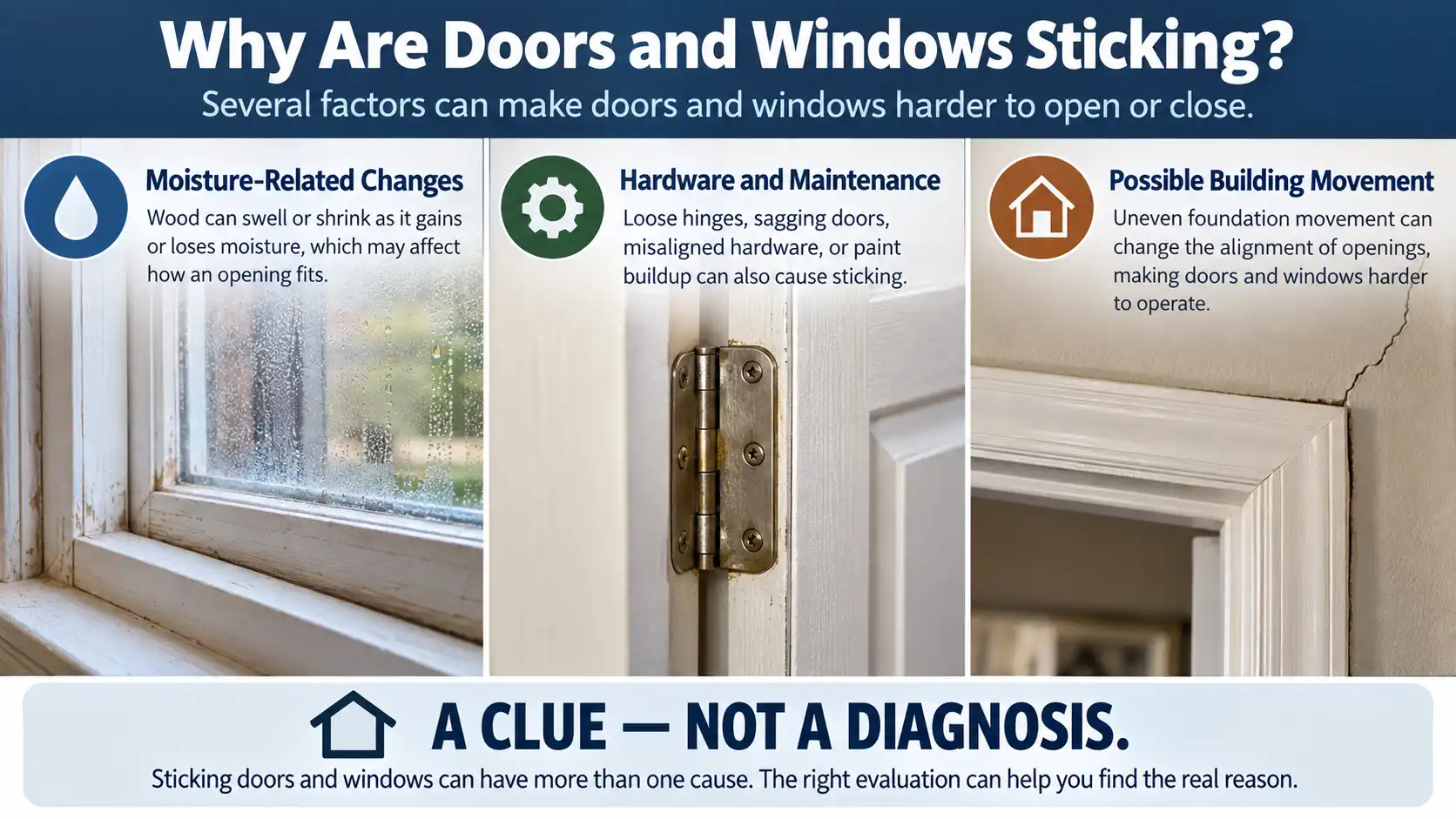
A bedroom door that closed easily last week now scrapes against its frame. A window takes more effort to open. You may be wondering whether something has changed beneath your home.
Sticking doors and foundation problems can be connected, but sticking alone is not a diagnosis. Loose hinges, installation issues, paint buildup, and changes in wooden components can also affect how an opening operates. These alternatives should be considered before assuming that foundation repair is necessary.
For St. Louis-area homeowners, a useful starting point is to ask three questions: When did the problem begin? Is one opening affected or several? What else has changed nearby?
Those observations can help you explain the problem clearly and decide what kind of professional evaluation to arrange.
Common Reasons Doors and Windows Start Sticking
Moisture Changes in Wooden Components
Wood exchanges moisture with the surrounding air. Under typical service conditions, it can swell as it gains moisture and shrink as it dries. The USDA Forest Products Laboratory explains this relationship in its guidance on moisture and the physical properties of wood.
That movement may affect the clearance between a wooden door or window sash and its frame. A sash is the part of a window that holds the glass.
Record whether the sticking comes and goes, whether it coincides with changes in indoor humidity, and whether you notice condensation or water staining. Do not use a seasonal pattern alone to rule out other causes.
Moisture damage also deserves attention. The National Park Service identifies rainwater and interior condensation as potential contributors to deterioration in wooden windows.
Loose Hinges, Sagging Doors, or Misaligned Hardware
A door may rub because its hinges are loose or inadequate, or because the door itself has sagged. A latch can also fail to meet its receiving plate because the hardware is misaligned.
The Foundation Performance Association includes these examples in its guide to conditions sometimes mistaken for foundation movement.
When describing the problem, distinguish between a door that rubs while moving and one that swings freely but will not latch. Tell the repair professional where it catches rather than simply saying that it is “stuck.”
Paint Buildup and Window Maintenance Problems
With older wooden windows, accumulated paint can interfere with movement. Damaged sash cords and deteriorated components may also need attention. The National Park Service’s guide to evaluating and repairing historic wooden windows discusses these conditions and the importance of assessing the window before choosing repairs.
Look for obvious obstructions and describe what happens when you operate the window normally. Does it stop at one point, resist movement throughout its travel, or fail to remain in position?
Avoid dismantling an unfamiliar window or applying a generic repair method. Start with the manufacturer’s instructions or a window professional familiar with that type of unit.
Installation Issues or Recent Work
An opening may have alignment problems unrelated to the foundation. For example, an improperly installed door can be out of plumb, meaning it is not vertically aligned, or have a misaligned latch.
Before scheduling an inspection, write down any recent door replacement, window installation, painting, flooring work, or nearby renovation. Ask whether the opening worked normally before that work.
The sequence of events is useful history. It is not, by itself, proof that the work caused the problem.
How Sticking Doors and Foundation Problems Can Be Connected
When different parts of a foundation move by different amounts, that uneven movement can affect the structure above it. A door or window opening may become distorted, changing how the door or sash fits.
Foundation movement is not always downward settlement. Upward movement, known as heave, is another possibility under certain soil and moisture conditions. The Foundation Performance Association’s foundation movement evaluation guidelines explain these distinctions and separate operating problems from structural conditions that affect a building’s ability to support loads.
For more background on the supporting ground, read our guide to common causes of foundation settlement.
The practical question is not simply whether the house has “settled.” It is whether the current symptoms indicate a condition that needs attention. Our explanation of house settling vs. foundation problems explores that distinction.
What Other Changes Should You Look For?
Look beyond the door or window itself. Note whether the sticking appears alongside new cracks near openings, widening gaps, noticeable floor changes, or similar operating problems elsewhere in the house. These observations deserve context rather than an automatic structural diagnosis.
You can use our guide to the warning signs of foundation problems to organize what you notice.
The following table suggests a next step, not a conclusion about your home’s condition.
| What you notice | A practical next step |
|---|---|
| One door has visibly loose or damaged hardware. | Have the door and hardware checked before assuming a foundation cause. |
| An older wooden window has accumulated paint or damaged operating components. | Arrange a window-condition assessment. |
| Several openings change while nearby cracks, gaps, or floor changes are also appearing. | Request a broader evaluation instead of treating every opening as a separate repair. |
| An opening needed for emergency escape cannot operate properly. | Prioritize restoring a usable escape route, regardless of the suspected cause. |
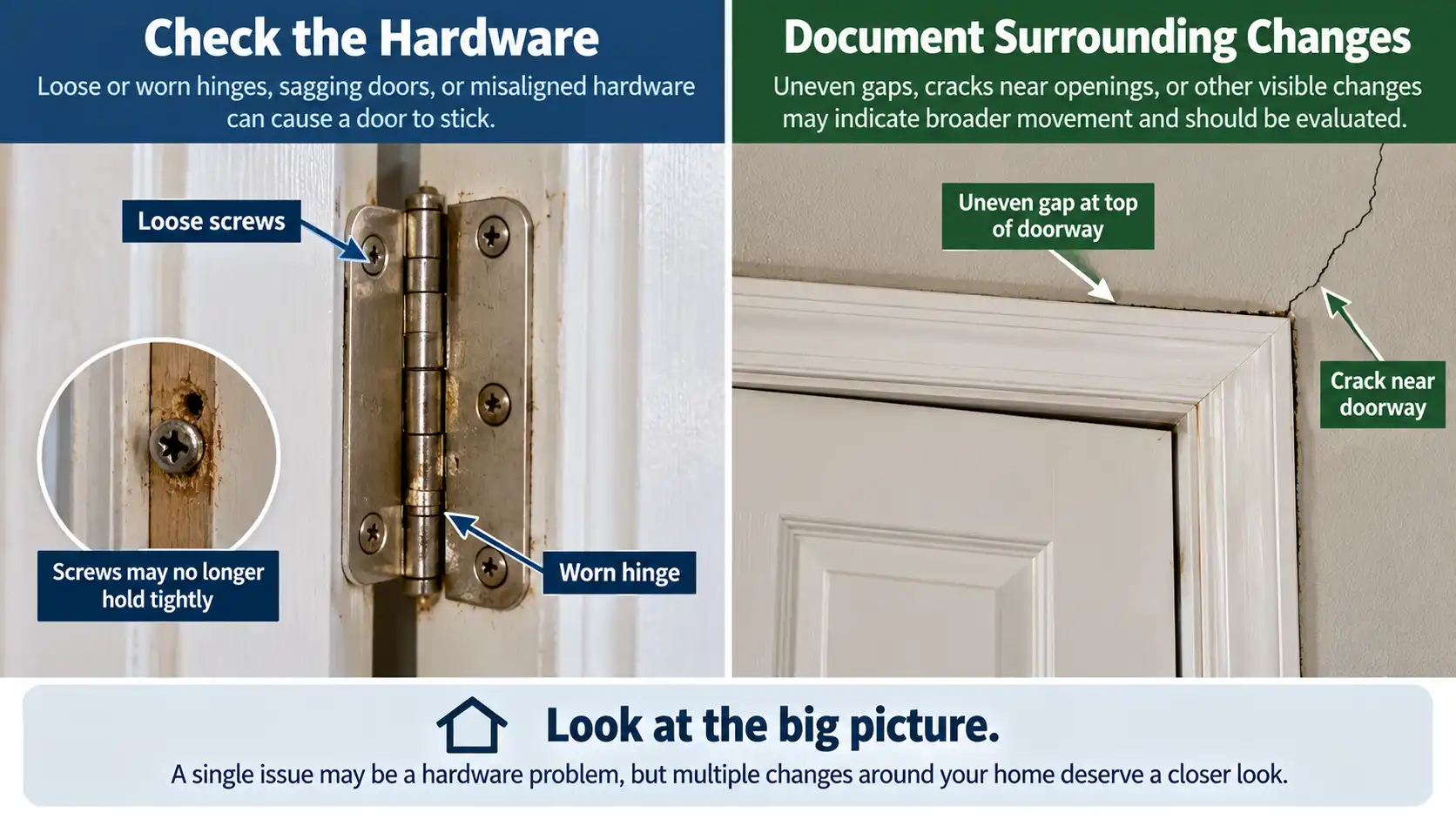
These next steps reflect the distinction between localized maintenance problems, broader building symptoms, and escape-route concerns.
A single affected door does not automatically rule out foundation movement. Likewise, several sticking wooden doors do not automatically confirm it. The goal is to investigate the pattern rather than count symptoms and declare a diagnosis.
What Homeowners Can Check Without Taking Anything Apart
You do not need to perform an engineering survey before asking for help. Prepare a short record of your observations.
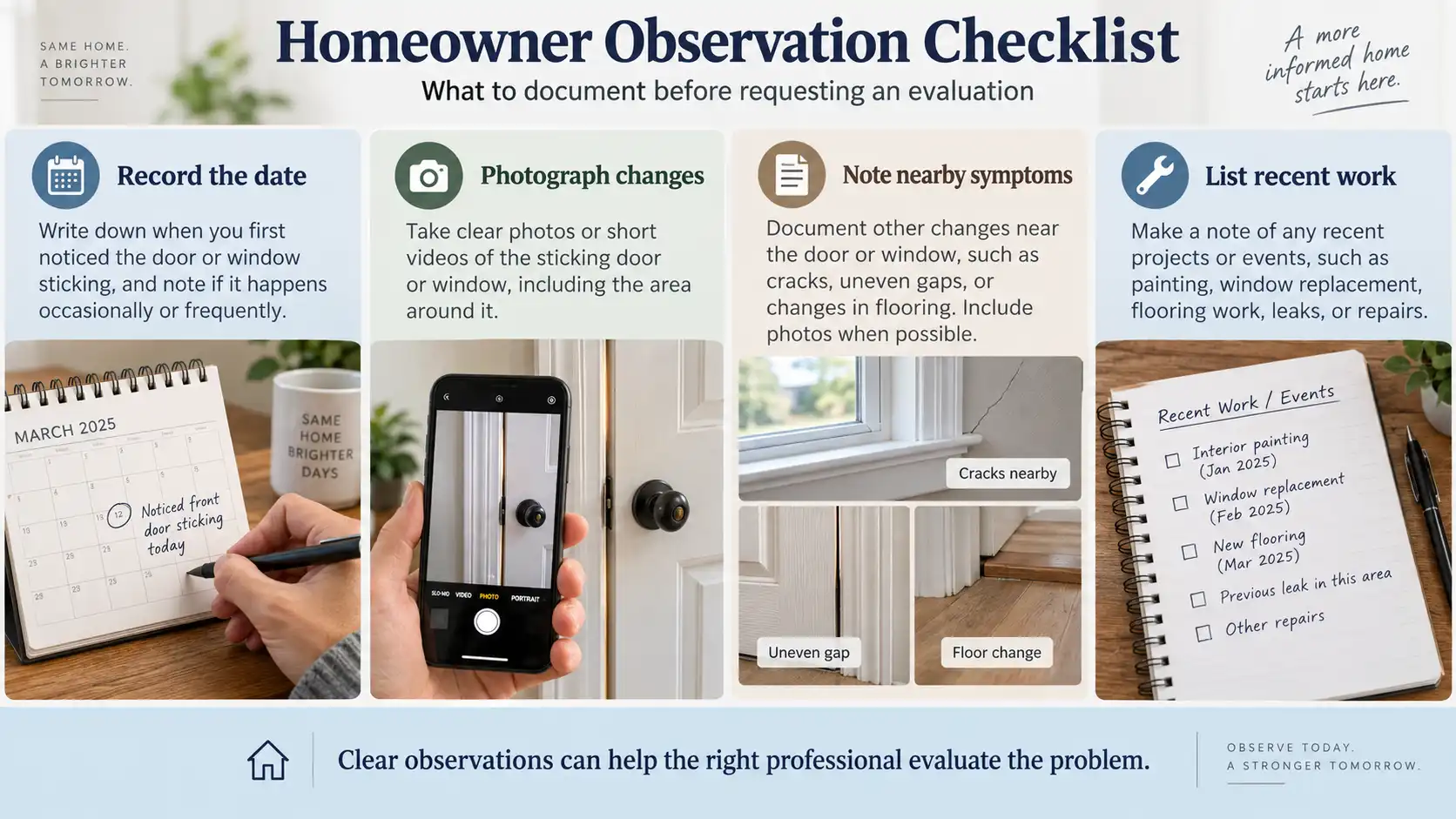
Record the date and location. Identify the specific opening, when you first noticed the problem, and whether its operation has changed since then. Distinguish “I noticed it yesterday” from “I know it started yesterday.”
Photograph the surrounding area. Take an overall photograph showing the opening and nearby wall, then closer photographs of visible gaps, rub marks, or cracks. Keep the original images with their dates.
Write down relevant history. Include recent work, known leaks, earlier repairs, and whether the same problem has returned. Bring previous inspection reports or photographs when available.
These records can help establish the history of the condition without asking you to determine its cause. Crack Wizard’s house-settling guide provides additional examples of observations to document.
Check Indoor Humidity as Background Information
A humidity meter can provide another useful observation. The EPA’s moisture-control guidance for homeowners recommends keeping indoor relative humidity below 60%, ideally between 30% and 50% when possible. It also advises addressing condensation and moisture sources.
A humidity reading is not a foundation test. Record it as background information, not as proof that the foundation is stable or moving.
Avoid forcing a stuck opening or removing trim and building components simply to investigate. Ask the appropriate professional to assess anything you cannot check safely.
Should You Adjust the Door or Have the Home Evaluated First?
For an apparently isolated hardware or window-maintenance problem, a qualified carpenter or door-and-window professional is a reasonable starting point. Ask them to identify why the opening is not operating correctly, rather than requesting a particular adjustment in advance.
When the cause remains unclear, the problem keeps returning, or other parts of the home are changing, request a broader evaluation. A licensed structural engineer may be appropriate when an independent structural assessment is needed. Foundation evaluation guidance considers the building’s history, visible conditions, and additional investigation when warranted.
Be Careful Before Sanding or Removing Paint
Do not make sanding or planing the automatic first response to a sticking opening.
There is also a separate paint-safety consideration: homes built before 1978 may contain lead-based paint. Before disturbing painted surfaces, review the EPA’s lead-safe renovation guidance and arrange appropriate testing or professional assistance. Sanding, scraping, cutting, and similar work can create dust that contains lead.
Give Emergency Escape Openings Priority
An opening used for escape needs attention even when the suspected cause is only hardware or paint.
The U.S. Fire Administration’s home fire escape planning guidance advises identifying two ways out of every room and keeping doors and windows unblocked.
Do not postpone addressing an unusable escape opening while waiting to see whether the season changes. Arrange prompt help to restore its operation and review your household’s escape plan.
Frequently Asked Questions
Do Sticking Doors Always Mean Foundation Problems?
No. Loose hinges, a sagging door, and installation-related alignment problems are documented alternatives to foundation movement. Determine why the opening is sticking before deciding that foundation repair is needed.
Why Do My Doors or Windows Stick During Certain Seasons?
Wooden components can change dimensions as their moisture content changes. That can affect their fit. Record the seasonal pattern, but do not treat it as a complete explanation when other symptoms are present.
Can Foundation Movement Affect Just One Door or Window?
It may affect an opening in one part of the home, but a single sticking opening cannot establish the cause. Neither the number of affected openings nor the absence of other obvious symptoms replaces an assessment.
Should I Adjust the Door Before Having the Problem Evaluated?
Have an obvious hardware problem checked, but explain any recurring sticking or surrounding changes before requesting an adjustment. When the explanation is unclear, seek an assessment rather than assuming that changing the door’s fit addresses the underlying issue.
Find the Cause Before Choosing a Repair
Start with observations: identify the affected openings, record what changed, and note anything happening nearby. Take that information to the professional best suited to evaluate the problem.
Find the Cause Before Choosing a Repair
Start with observations: identify the affected openings, record what changed, and note anything happening nearby. Take that information to the professional best suited to evaluate the problem.
For homeowners concerned about possible foundation movement, Crack Wizard provides foundation repair services in St. Louis and surrounding areas, including foundation inspections.
Request an inspection to discuss what you are seeing and determine the appropriate next step. You do not need to decide on a repair before the condition has been evaluated.