
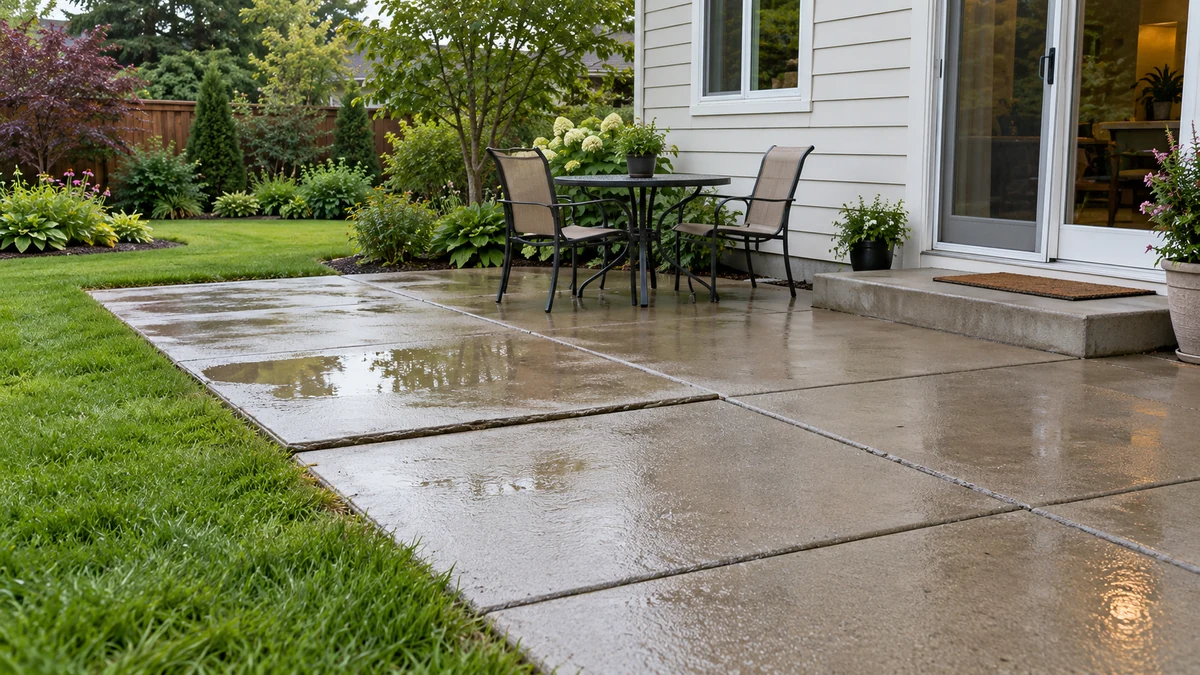
A sinking concrete patio usually points to a change in the soil or base supporting it. Fill can compress, water can carry material away, and moisture changes can alter the ground beneath a panel. But an uneven joint does not tell you which side moved, and a puddle alone does not establish the cause. The useful next step is to assess the patio’s support, drainage, and relationship to the house before choosing a repair.
Unlike an isolated garden path, a patio often meets a doorway, steps, landscaping, and outdoor structures. A successful plan must make those connections work together, rather than simply raise the lowest-looking corner.
Why a concrete patio can lose support
Settlement in the base or underlying fill
The concrete rests on supporting material that needs to remain stable. If fill beneath the patio continues to compress, the slab can drop with it. Different depths of fill or previously disturbed ground can produce uneven movement across the same patio. A former utility trench or an addition to an older patio may be relevant history, although neither proves a construction defect.
Some soils also change volume as moisture conditions change. The American Concrete Institute’s public slabjacking summary identifies settlement, erosion, flooding, and soil or base shrinkage as reasons slabs on ground can shift. Which mechanism applies at your home requires an on-site assessment.
Runoff, erosion, or an ongoing water source
A downspout emptying beside the patio, runoff from a higher planting bed, or repeated overflow at an edge deserves attention. Water may soften susceptible support material or transport particles where a flow path exists. A low spot can also collect water after movement has already occurred, so the puddle may be an effect rather than the original cause.
Wet ground that persists through dry weather, a change associated with irrigation use, or unexplained water use can justify checking plumbing or irrigation. These are clues to investigate, not proof of a buried leak. Tell the evaluator about known lines and arrange appropriate leak assessment when indicated; lifting the slab would not repair a leaking pipe.
Is the patio sinking, or is another section rising?
A joint with one high edge can result from downward settlement, upward movement, or both. During freezing weather, ice lenses can develop in susceptible soil with an available water supply and push the surface upward. Thawing can then weaken support. The FHWA discussion of frost-susceptible soils explains these mechanisms in pavement engineering; it is useful background, not a residential repair specification.
Compare dated observations through the seasons if you have them. A change that appears each winter and partly reverses in spring calls for a different investigation from a steadily enlarging drop. Nearby tree growth may also be relevant, but an uneven patio is not permission to cut roots. Have the concrete evaluator and a qualified arborist coordinate if roots are suspected.
What to notice before the evaluation
You can collect useful information without drilling, excavating, or crawling beneath an unsupported edge. From a stable walking area, note:
- Where water remains: record the puddle’s location after ordinary rain and whether it clears or persists
- Where the surface changes: photograph offset joints, cracks, tilted panels, and gaps beside steps from consistent viewpoints
- What changed around it: mention recent landscaping, irrigation work, drainage alterations, or patio extensions
- How use is affected: identify a chair that rocks in one location, a table that now tilts, or a route that has become difficult to cross
Furniture can provide a practical clue, but check that the furniture itself is sound. Photographs document appearance; they cannot reveal soil condition, establish a void, or determine whether lifting is safe. Keep people away from unstable edges and obvious trip areas while arranging evaluation.
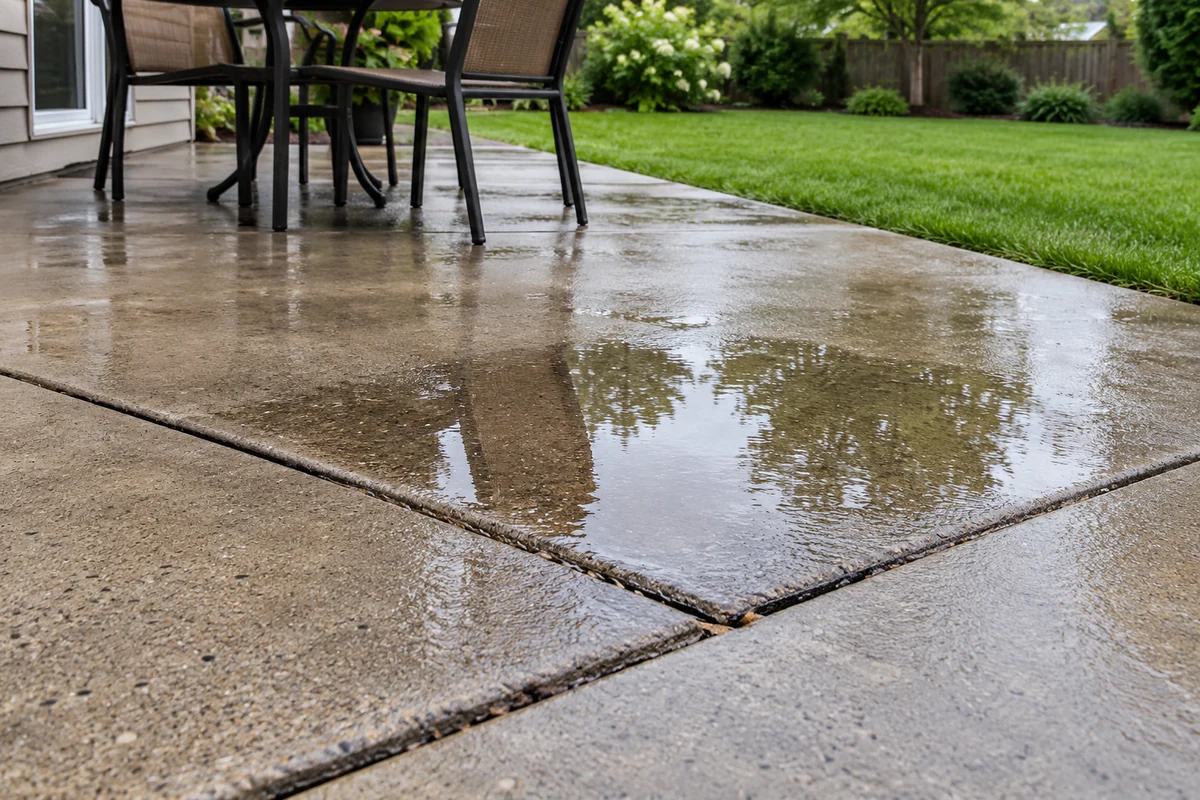
Why drainage slope matters more than perfect level
A patio normally needs a deliberate drainage path. Making every panel perfectly horizontal can leave water trapped, and raising an outer edge without checking elevations could redirect runoff toward the house. Ask where water should go after the repair and how the proposed elevations preserve that route.
The Building America Solution Center’s patio drainage guidance explains why hard surfaces near a house should direct runoff away from the foundation. Actual slope, drainage outlets, and any local requirements need site-specific review, especially where walls, lot boundaries, or landscaping restrict the outlet.
If patio runoff coincides with basement seepage, discuss both observations. Concrete work and basement waterproofing evaluation address related but different questions. Improving a patio’s slope alone is not a guarantee that an existing basement leak will stop.
Check doorways, steps, and structures before lifting
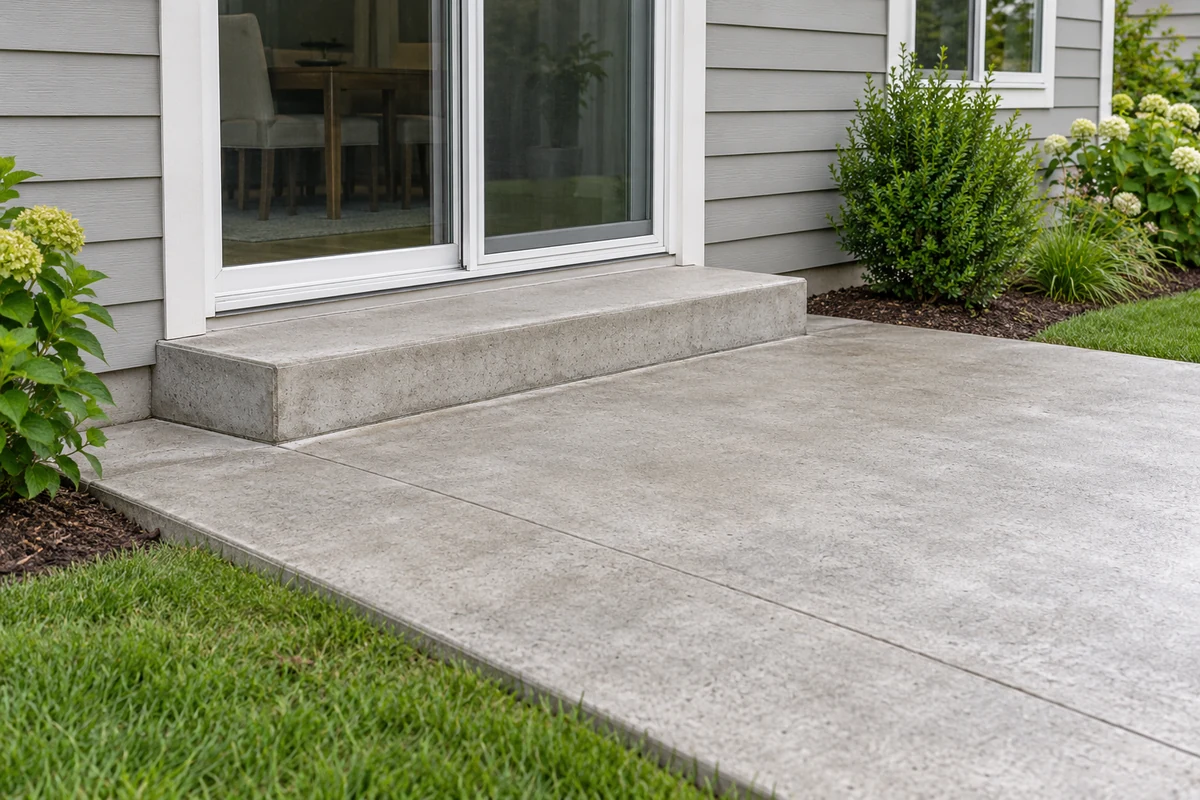
The door threshold is a constraint, not a target height. Raising concrete too far can interfere with a door or leave inadequate clearance at siding and other building details. Changes beside steps can alter the step-to-patio transition. The evaluator should measure these interfaces and account for joints, existing connections, and the route used to enter the house.
An ordinary ground-supported patio is not automatically part of the house’s foundation. However, a patio carrying roof posts, pergola supports, masonry, or an attached enclosure needs closer attention. Do not assume that a visible post has an independent footing or that moving its surrounding slab is harmless. A qualified professional should establish what carries the load before work is planned. Separate movement in walls or structural supports may warrant structural foundation evaluation.
When keeping the existing patio may make sense
A reasonably intact panel with changed elevation may be a candidate for professional lifting once its support conditions and movement constraints are understood. The decision includes whether the proposed lift can improve the needed drainage slope without creating a new problem at the doorway, neighboring panel, or steps.
Extensive breakup, badly deteriorated concrete, an unsuitable layout, or a drainage geometry that cannot be achieved by moving the existing panels may favor replacement or a broader redesign. Some projects need drainage or utility work before concrete repair. Decorative finishes add another consideration: discuss the appearance of repaired cracks, injection-hole patches, and any replaced section rather than expecting an invisible match.
Ask for an explanation of the suspected cause, the planned finished elevations, and any work outside the lifting scope. Product selection, access restrictions, return-to-use instructions, and warranty terms should be specific to the proposed project.
Frequently asked questions about sinking patios
Does a puddle mean my concrete patio is sinking?
Not necessarily. Puddling can reflect original surface shape, drainage obstructions, or later movement. Dated observations and elevation measurements help an evaluator distinguish these possibilities; a puddle alone cannot identify the cause.
Should a repaired patio be perfectly level?
Usually the goal includes a planned drainage slope rather than a perfectly horizontal surface. The proposed elevations should direct runoff appropriately while respecting doors, steps, adjoining panels, and site constraints.
Can a patio be lifted if it supports pergola or roof posts?
That needs a load-path assessment first. A professional must establish whether the posts have independent footings or load the slab and how movement could affect the structure. Ordinary patio lifting should not be assumed suitable.
Will lifting my patio fix a leak beneath it?
No. A suspected plumbing or irrigation leak needs its own investigation and repair. An ongoing water source can continue affecting support conditions even after a panel is raised.
Will lifting make cracks and patch locations disappear?
No. Raising a panel does not restore broken concrete or guarantee an invisible finish. Discuss crack treatment, injection-hole patches, and the appearance of any replacement sections before choosing a repair.
Get a patio-specific repair assessment
If a sinking concrete patio is changing how water drains or making your outdoor space difficult to use, learn about Crack Wizard’s PolyJacking and concrete lifting services. An assessment can help determine whether the existing panels can be retained and what drainage, support, or interface concerns need attention alongside them.