
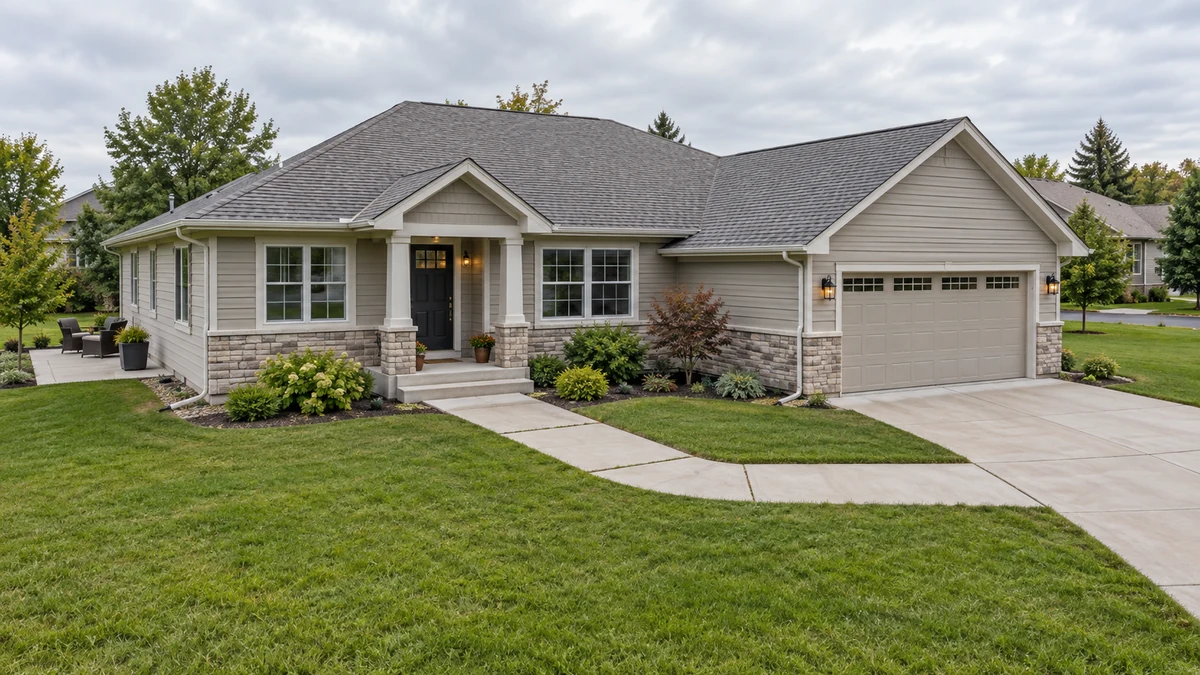
Concrete around a house can settle when the soil or base supporting it compresses, shrinks, or is carried away. The change may affect one corner, a narrow strip, or several separate slabs. Common concrete settlement causes include changes in disturbed ground, uneven moisture, and loss of support. An uneven joint alone does not tell you which process occurred, or whether the house itself moved.
The most useful starting point is to look at the whole property: where the movement appears, what meets that surface, and where water travels. A walkway beside the house and a slab across the yard may have very different support conditions even though they look alike.
Why ground beside a house can behave differently
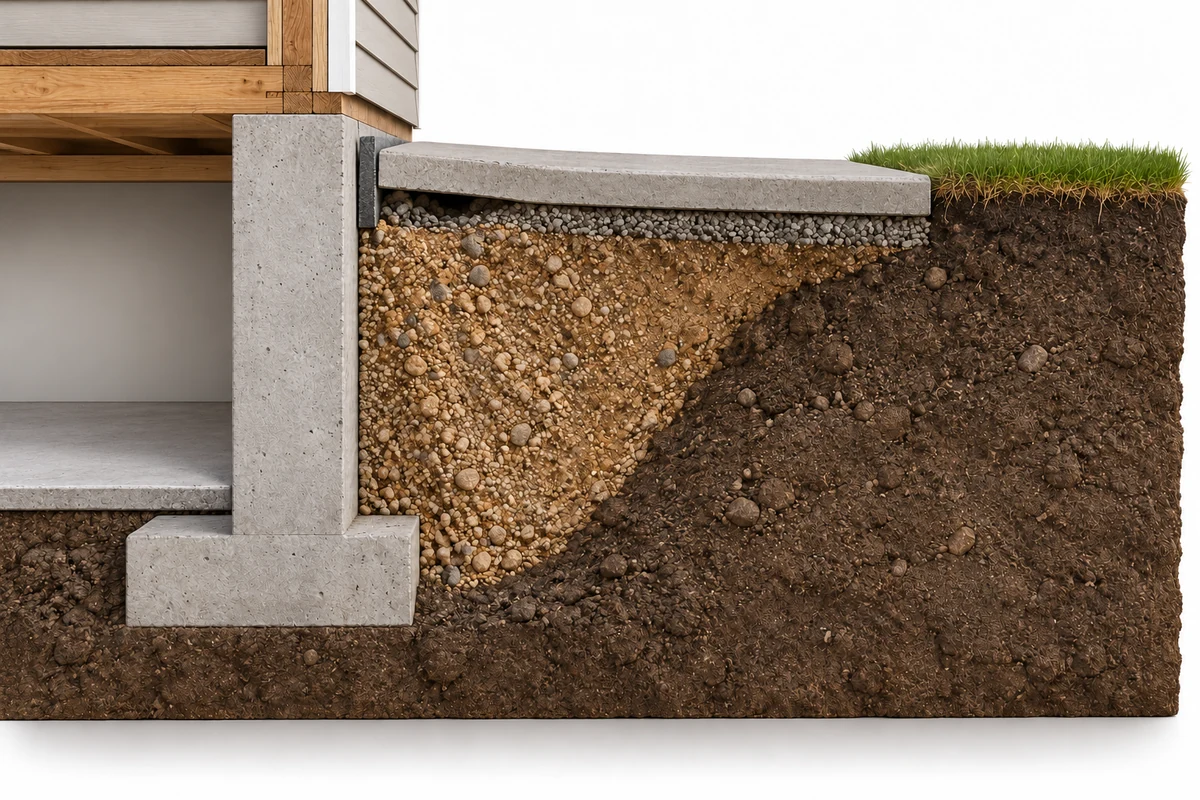
Building a house disturbs some ground and leaves other areas relatively untouched. Excavation around a basement is later backfilled. Utility installation can create narrower trenches across a yard or beneath future walks. Additions, drainage work, and landscaping may introduce further patches of replaced soil.
That history matters because placed soil does not automatically have the same density or behavior as adjacent undisturbed ground. Where fill was unsuitable or insufficiently compacted for its intended use, it may compress after concrete is installed. A slab spanning different support conditions can move unevenly rather than drop as one level piece.
This does not mean every slab near a house sits on poorly compacted fill. Construction methods, fill materials, and preparation vary, and original soils can also be problematic. Old plans, installation photographs, or records of buried-line repairs are useful clues, not proof of the cause.
HUD’s Durability by Design guide discusses backfill settlement alongside site grading and surface drainage. Its broad residential guidance helps explain why ground preparation and runoff belong in the same conversation; it does not establish what happened beneath an existing slab.
Different sides of the house receive different amounts of water
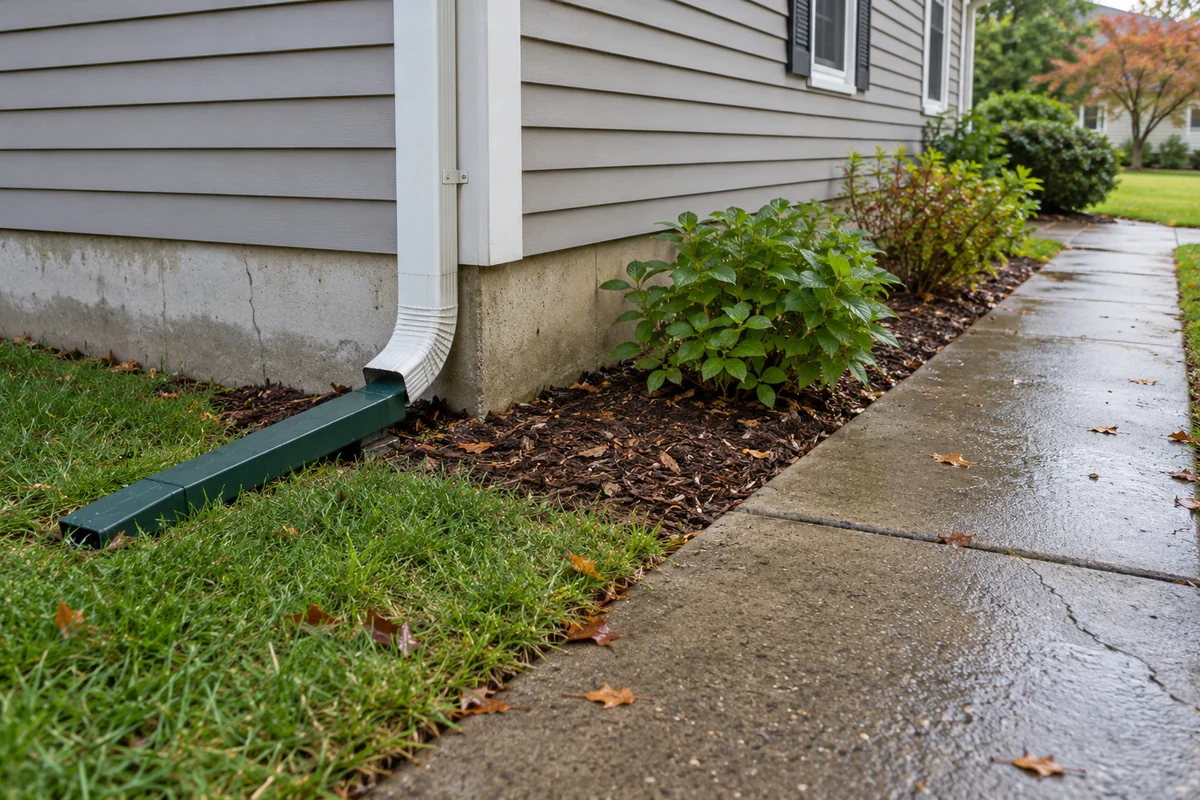
Exterior concrete rarely experiences one uniform moisture condition. A sheltered strip beneath an overhang may stay relatively dry, while another edge receives roof runoff. A frequently watered garden, a low side yard, and a repaired utility trench can each create a different setting along the same route around the house.
Some soils lose volume as they dry; others lose supporting strength when very wet. Moving water can remove supporting material where a flow path and an outlet exist. These processes are related to moisture, but they are not interchangeable. A puddle does not prove washout, and a dry summer does not prove that shrinkage caused a particular gap.
The American Concrete Institute’s public slabjacking abstract identifies settlement, erosion, flooding, and shrinkage of underlying soil or base as reasons slabs on ground can shift. That list is a starting point for investigation, not a diagnosis from a photograph.
Observe runoff from a sheltered, safe place during ordinary rain. Note an overflowing gutter, an outlet discharging beside a slab, or water collecting where two surfaces meet. If moisture is also entering the basement, discuss the relationship with the site’s waterproofing and drainage evaluation. Changing a slab’s height alone does not identify or correct every water source.
Settlement, heave, and erosion describe different changes
Settlement is downward movement. Heave is upward movement. Erosion describes material being removed; it may create conditions for settlement, but the terms are not synonyms. At a raised-looking joint, the high panel may have risen, the low panel may have settled, or both may have moved.
Moisture-sensitive expansive soils can swell when wetted and shrink when dried. Where frost-susceptible soil, freezing temperatures, and available water occur together, frost heave is another possibility. The Federal Highway Administration’s discussion of expansive and frost-susceptible soils explains these mechanisms. Its pavement guidance supports the distinction, not residential repair specifications.
Dates and repeat photographs help separate a recurring seasonal pattern from a change that appears to persist. Neither pattern by itself establishes the underlying soil condition. Likewise, a crack without an elevation difference may have another cause. Do not treat every crack as evidence that the slab has sunk.
Read the connections between walks, patios, driveways, and steps
Separate concrete surfaces may have been installed at different times, over different bases, or with different intended slopes. Their meeting points make movement noticeable, but an adjacent surface is not automatically a fixed reference.
- Walk to driveway: Photograph both approaches to the joint. Is one walkway panel affected, or does the change continue across several driveway panels?
- Walk to steps: Record whether the bottom step now appears different in height from the others. Do not assume the steps share the walk’s support system.
- Patio to side path: Note whether water collects at the connection or continues along the path. A lower-looking area may include an intentional drainage slope.
- Slab to house: Photograph any changing gap and the nearby door or wall for context. A joint intended to separate materials is not, by itself, damage.
A narrow affected band crossing otherwise different surfaces is worth pointing out, particularly if it matches documented excavation. So is movement concentrated at one wet corner. These observations guide questions; they do not justify digging to confirm a suspected trench.
Make a useful record without disturbing the ground
Draw a simple plan and label each affected area. For each location, record the date, recent weather, visible gaps or offsets, and any change in drainage or access. Take a wide photo showing the surroundings and a close photo from the same position on later visits. Include older pictures if they show how the surfaces previously met.
Tell the evaluator about additions, plumbing or utility repairs, replaced concrete, and changed downspout outlets. Separate what you witnessed from what you suspect. “Water remains at the patio-to-walk joint after rain” is more useful than “the whole foundation is sinking.”
Avoid stepping on rocking panels, reaching under unsupported edges, probing the soil, or deliberately flooding an area. Keep people away from unstable concrete and use another route around trip hazards. Sudden movement, an expanding ground opening, or damage affecting safe entry warrants prompt professional attention rather than continued observation.
Exterior slab movement is not automatically foundation movement
Walks and patios often function as ground-supported flatwork, separate from the system carrying the house. Their support conditions and loads differ. A settled walk can therefore exist without settlement of the house, while exterior concrete alone cannot rule out a foundation concern.
If there are also new or changing foundation-wall cracks, visible wall movement, or changes around doors and windows, arrange a foundation evaluation and describe the exterior observations too. Structural or geotechnical expertise may be needed when the pattern extends beyond flatwork. Raising an exterior slab is not a substitute for evaluating house support.
A repair assessment should establish what moved, whether the concrete is suitable to retain, how adjoining surfaces limit adjustments, and what contributing conditions need attention. Lifting, replacement, drainage work, or a combination may be appropriate depending on those findings.
Frequently asked questions
Why can concrete next to a house settle more than concrete farther away?
The ground near a house may include backfill or later excavation, while a more distant slab may rest on different soil. Moisture and drainage also vary across a property. Proximity alone does not prove poor compaction or explain which surface moved.
Can a utility trench affect more than one concrete surface?
A backfilled trench can cross a yard beneath separate slabs. If its support behaves differently from adjacent ground, movement may appear along that route. Construction records and the pattern are useful clues, but a professional must evaluate whether the trench is actually involved.
Does an uneven joint mean one slab has settled?
Not necessarily. One panel may have settled, another may have heaved, or both may have changed. Some slopes are intentional. An evaluation compares elevations and context rather than assuming the higher panel stayed fixed.
Do sunken sidewalks mean the house foundation is sinking?
No. Exterior flatwork and the house foundation can have different support conditions. A settled sidewalk does not establish foundation movement. New wall movement or other building changes should be evaluated separately and discussed alongside the exterior observations.
What should I document before requesting an evaluation?
Record affected locations, dates, recent weather, water paths, and changes at joints or steps. Take wide and close photographs from safe locations, and share records of excavation or repairs. Do not probe beneath slabs, test rocking panels, or flood an area to investigate.
Start with the pattern, then choose the repair
For settled exterior concrete around your St. Louis-area home, ask Crack Wizard about a PolyJacking and concrete-lifting assessment. Bring your property sketch and photographs so the discussion includes the affected slabs, nearby water paths, and connections to steps or the house. The goal is a repair plan that fits the observed conditions.